








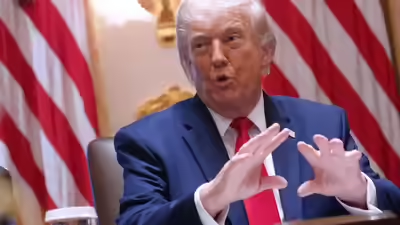
President Donald Trump has yet to approve a proposed agreement with Iran following a meeting in the White House Situation Room, with a White House official saying any deal must satisfy the US president’s conditions.Trump spent about two hours in the White House Situation Room on Friday reviewing a potential framework aimed at ending the conflict, but no final decision emerged from the meeting. Following the talks, a White House official said, “President Trump will only make a deal that is good for America and satisfies his red lines,” as quoted by AFP.“Iran can never possess a nuclear weapon,” the official added.The comments came as the White House signalled that a possible agreement was under consideration, while Iranian officials insisted negotiations had not yet reached the final stages.Iranian Foreign Ministry spokesman Esmaeil Baqaei said exchanges between the two sides were continuing but maintained that “no final agreement has been reached yet.” He also rejected suggestions that Tehran was negotiating under US-imposed conditions, saying Iran “said goodbye to the language of ‘must’ 47 years ago.”Trump had earlier outlined what he described as the broad contours of a possible deal, including the reopening of the Strait of Hormuz, the lifting of blockades affecting maritime traffic and coordination on Iran’s enriched uranium stockpiles.However, Iranian state media challenged several of those claims. Sources quoted by the Fars news agency described Trump’s account as a “mixture of truth and lies,” disputing assertions related to the fate of Iran’s nuclear material and the terms governing shipping through the Strait of Hormuz.According to the report, Tehran is seeking the release of billions of dollars in frozen Iranian assets as part of any future arrangement.The uncertainty surrounding the negotiations has kept energy markets on edge, with investors closely watching developments that could affect shipping through the Strait of Hormuz, one of the world’s most important oil transit routes.Meanwhile, tensions across the wider region remained high. Iran and the United States have continued to accuse each other of violating a recently announced truce, while fighting between Israel and the Iran-backed Hezbollah movement in Lebanon showed little sign of easing.Israeli Prime Minister Benjamin Netanyahu said Israeli forces had advanced deeper into Lebanon, while Hezbollah claimed responsibility for a series of drone strikes targeting Israeli military positions in the country’s north. Both sides have continued to trade accusations of ceasefire violations despite ongoing diplomatic efforts.