








Nature has equipped its creatures with specialised mechanisms to survive in the environment, be it eels that hunt prey by sending electric shocks, pitcher plants that eat insects, puffer fish that inflate with spike amid danger or the scorpion that has a poisnous stinger which helps it when threatened.Arthropods like scorpions are masters of the hunt, utilizing specially adapted physical tools to subdue prey and keep away threats using their stingers filled with potent venom.For years, scientists have understood the reason behind these metal ‘fortifications’ have remained largely a mystery.Recent advancements in imaging and micro-analysis suggest that an animal’s behaviour and its physical anatomy, like the armor of a scorpion, is as complex as the evolutionary path that built it.
Scorpions’ stringers are ‘fortified’ with metals!
A new study published in the Journal of the Royal Society Interface has provided a much clearer look at how scorpions arm themselves.Researchers from the Smithsonian’s National Museum of Natural History and the Museum Conservation Institute studied 18 different species, discovering consistent patterns in where metals like zinc, manganese, and iron are placed.
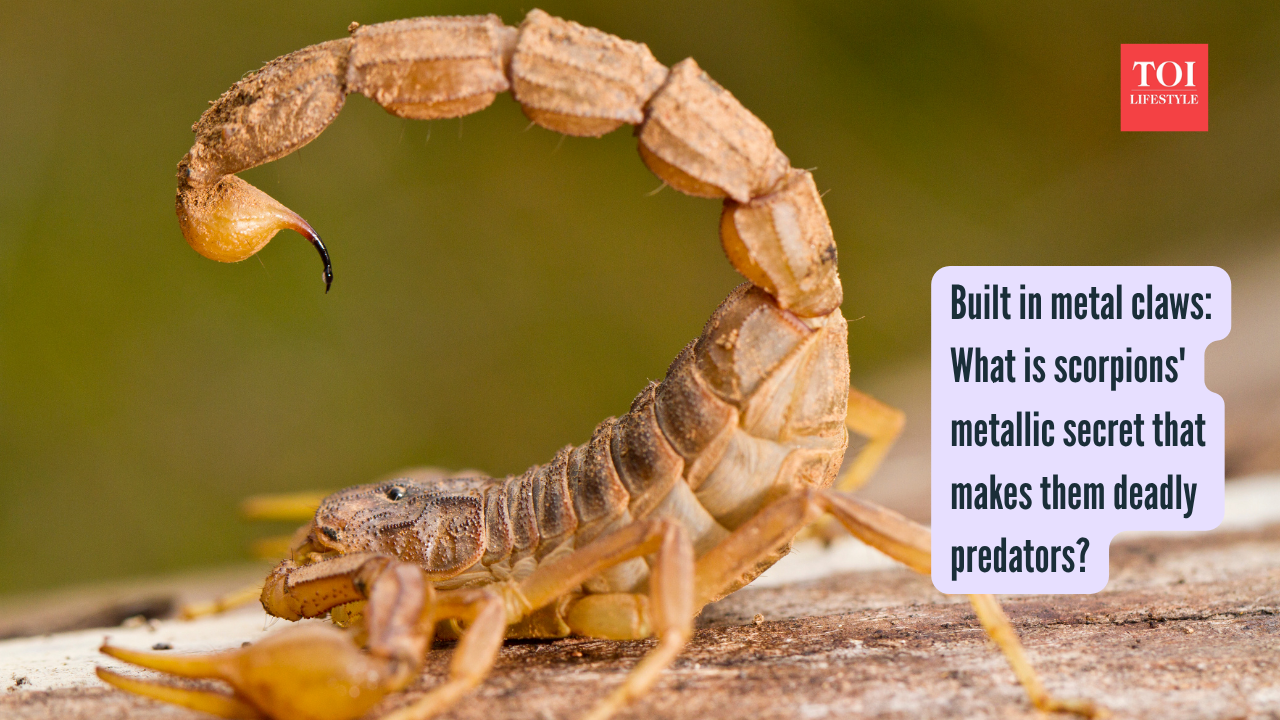
Scorpion (Photo via Canva)
“The microscopic-scale methods we used allowed us to identify individual transition metals in extremely high detail, showing us how nature skillfully engineered these metals in the scorpion’s weapons,” said Edward Vicenzi, a co-author of the study. In their stingers, for example , zinc is concentrated at the very tip for piercing, followed by a layer of manganese which lies just beneath it to provide structural support.
Why are these metals arranged in a proper order?
The metals are not just randomly distributed it appears to be carefully localised to the areas of highest stress. For example, in the pincers, these metals were found specifically along the cutting edges, which endure the most mechanical force when the scorpion grips its prey.Sam Campbell, a lead researcher on the project, explained the reason behind it, “We decided to use microanalytical techniques to unravel where and how these metals are distributed in the scorpions’ weapons to offer a clue as to how and why metal enrichment has been carried through the scorpion family tree”. This placement of metals makes sure that the scorpion’s weapons are durable and effective without wasting energy on reinforcing parts that do not need it.
Metals are strategically placed
Perhaps, the most surprising discovery was that higher levels of zinc were always not present in places of more force instead it was present at places where more piercing power is required.Sam Campbell the lead researcher said, “This points to a role for zinc beyond hardness, perhaps playing a bigger role in durability”. The researchers concluded that the metal enrichment is an evolutionary adaptation, directly related to how each species captures its food.