







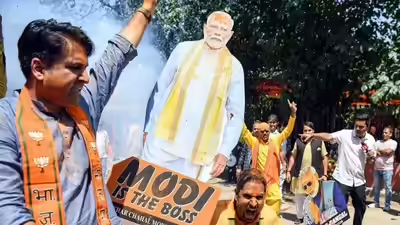
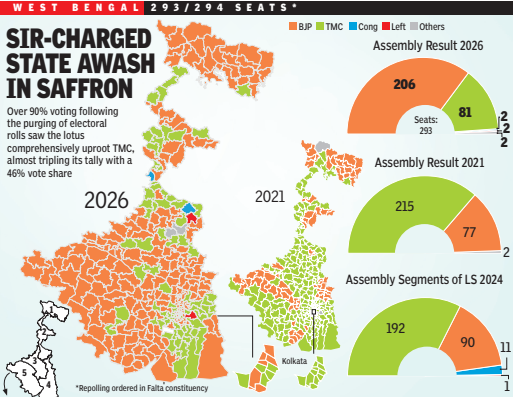
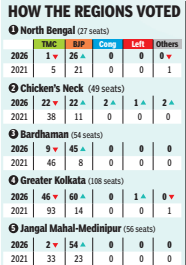
Throughout the campaign, Mamata Banerjee leaned on her 2021 playbook, asserting that she was the ‘sole candidate’ across all 294 seats. This time, however, the strategy that had fended off anti-incumbency backfired. Voters were not going to make the same mistake again.In a political earthquake that ended 15 years of Trinamool Congress dominance in Bengal, a powerful anti-incumbency wave swept BJP to a historic debut in the state. As counting for the assembly election drew to a close on Monday, the saffron surge dismantled Trinamool’s rural and urban strongholds alike – from border districts to the CM’s home turf of Bhabanipur in south Kolkata – signalling a deep-seated public exhaustion with what many voters described as “systemic misrule”.
.
“Didi said she was the candidate everywhere, but when we looked at our broken roads and closed-down schools and the local netas demanding ‘cut-money’ for every house repair, we didn’t see her face. We saw the faces of local bullies,” said Animesh Mondal, a schoolteacher in North 24 Parganas, the suburban district adjoining Kolkata.“Trinamool simply could not consolidate its vote share,” said Zaad Mahmood, associate professor of political science at Presidency University. “BJP’s vote share increased significantly, but more importantly, TMC’s share dropped. We saw a crucial shift where the Muslim vote split, while a large portion of the majority Hindu vote consolidated in favour of BJP. It is, fundamentally, Trinamool’s own failure to hold its ground,” said Mahmood.Driving the anti-incumbency sentiment was a stagnant industrial landscape. Despite years of promises, the lack of private-sector investment has forced a generation of Bengali youth to seek work in states like Karnataka, Maharashtra, Delhi and Gujarat.
Trinamool tried to mitigate this through a youth dole. Though there were lakhs of takers for the monthly stipend, the deeper resentment of not finding jobs in the state remained. “I don’t want Rs 1,500 to sit idle; I want a job that respects my degree,” said Subhamoy Das, 24, an engineering graduate from Hooghly who now works as a data-entry operator at Sealdah. “The dole was a reminder that the govt had no real plan for our future. They wanted to buy our silence, not build our careers.”Rampant corruption across party ranks also fuelled anger. From the school recruitment scam that saw thousands of eligible candidates protesting on the streets to the local-level “tolabazi” (extortion), the perception of a ‘mafia raj’ permeated the electorate. “A number of schools in my locality run without proper teachers. I am forced to enrol my child in a private school, despite meagre earnings. Who do you expect me to vote for?” asked Sunil Bhakat, a resident of rural Howrah.“We have struggled to survive, but local netas never shy away from flaunting their ill-gotten fortune,” said Anup Ghosh, a pharmacist from Serampore, Hooghly. “The development works never reached the last mile because the party cadre acted as a filter,” noted Sheikh Rahamatullah, a labour contractor from Murshidabad.Also Read | Assembly elections result: BJP is Bengal Janata’s Party, Vijay Divas in Tamil Nadu, Keralove for Congress“Even the middle class and upper middle class Muslim families are fed up. For years, we were treated as a loyal ‘vote bank’ to be secured with doles. We want quality education and infrastructure, not just an identity-based rhetoric that keeps us trapped in poverty,” he added.Political analysts observed that Mamata’s failure to address internal party rot proved fatal. Her insistence on overseeing every seat blinded her to the disconnect between her administration and the common citizen.“She overlooked the corruption in her own backyard for too long,” said Sunita Banerjee, a homemaker in south Kolkata. “While she was busy with national ambitions, the roads turned to craters and the transport system collapsed. Trinamool’s harping on ‘Bengal Asmita’ (Bengal’s self-respect) remained meaningless rhetoric without the job opportunities we were promised,” Milind Goswami, a tutor, said.