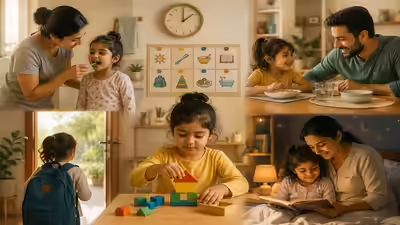








School teaches children how to read, calculate, compete and prepare for the world outside. Home teaches something quieter, but often far more lasting: how to live with people, how to respond to hurt, how to carry responsibility, and how to become someone others can trust. These lessons are not written on a whiteboard or graded in a report card, yet they shape the rest of a child’s life in ways that are impossible to ignore. Scroll down for seven things children learn at home that no school can teach.
Love that feels safe
The first lesson children absorb at home is what love actually feels like. Not the dramatic kind seen in movies, but the steady, daily kind that says, “You are safe here.” A child who grows up around warmth learns that love does not have to be earned through perfection. It can be expressed through presence, patience, and protection.This becomes the emotional blueprint they carry into adulthood. Long before they understand relationships, they understand whether closeness feels comforting or threatening. Home quietly teaches them whether affection is dependable or conditional.
How to handle conflict
Every home has conflict. What matters is not whether disagreements happen, but how they are handled. Children watch closely when adults argue, apologise, stay silent, or explode. They notice whether anger becomes cruelty, whether voices rise and calm down again, whether problems are solved or simply buried.No school lesson can teach a child how to survive conflict with dignity quite like home can. When parents disagree respectfully, children learn that tension does not have to destroy love. They learn that even strong emotions can be managed without humiliation.
Responsibility before readiness
At home, children often learn that responsibility begins before they feel fully ready for it. They are asked to put away their toys, help with small tasks, care for belongings, or think about how their actions affect others. These may seem like ordinary household routines, but they help children realise something essential: life expects effort, not just intention.A child who learns responsibility at home grows up understanding that being part of a family means contributing to it. That idea becomes the foundation for discipline, reliability and respect later in life. School may assign homework, but home teaches duty.
Respect for boundaries
Children do not learn boundaries only from being told “no.” They learn them when adults model what healthy limits look like. At home, they discover that privacy matters, personal space matters, and kindness does not mean saying yes to everything.This is one of the most valuable lessons a child can receive. A home with clear boundaries teaches children that love and limits can exist together. They learn that respect is not about fear, but about recognising that every person has needs, emotions and rights.
How to care for others
Empathy is not born in theory. It grows in daily life. Children learn it when they watch a parent check on a tired grandparent, comfort a sibling, help a neighbour, or speak gently to someone who is struggling. They also learn it when they are encouraged to notice how their own words and actions affect other people.Home is where a child first understands that the world does not revolve around them. That understanding is powerful. It builds compassion, patience and emotional intelligence, traits that no textbook can fully install.
How to manage disappointment
At school, children are often measured by marks, rankings and performance. At home, they learn what to do when things do not go their way. A broken promise, a denied request, a delayed reward or a difficult family moment can all become lessons in resilience.If adults at home meet disappointment with calm honesty, children begin to understand that disappointment is not disaster. They learn they can cry, adjust, wait, try again. That emotional steadiness is a life skill, not a classroom subject.
Who they become when no one is watching
Perhaps the deepest lesson home teaches is identity. Children do not just learn what to do there; they learn who they are. In the way they are spoken to, corrected, encouraged and believed in, they begin to form their inner voice. That voice often stays with them for years.Home becomes the place where character is built in small, invisible ways. It shapes how they speak to themselves, how they treat others, and how they react when life gets hard. School may prepare them for exams. Home prepares them for existence itself.In the end, the most important lessons are often not the loudest ones. They happen at the dinner table, in the middle of disagreements, while cleaning up toys, while watching how adults behave under pressure. Long after school lessons fade, these home lessons remain, quietly, deeply, and for life.