








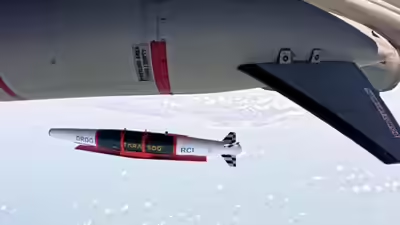
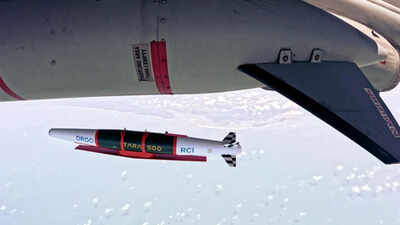
On May 7, 2026, the Defence Research and Development Organisation (DRDO) and the Indian Air Force (IAF) successfully carried out the maiden flight trial of the Tactical Advanced Range Augmentation (TARA) weapon off Odisha’s coast. TARA, released from a Jaguar aircraft, is India’s first indigenous glide weapon system designed to convert unguided warheads into precision-guided weapons. Developed by Research Centre Imarat, Hyderabad, with support from other DRDO labs and Indian industries, TARA enhances lethality and accuracy at low cost, while production has already commenced with industry partners.The key advantage of TARA lies in its stand-off capability, allowing pilots to release bombs from outside hostile air defence coverage. Once deployed, the bombs glide at high subsonic speeds, making interception difficult. This innovation mirrors global trends: earlier in the week, Israel’s Elbit Systems showcased its REST (Range Extension & Smart Tail) kit, which transforms standard warheads into precision strike weapons with ranges up to 120 km. REST employs deployable wings, smart tail guidance, and INS/GNSS navigation with anti-jamming resilience, achieving a circular error probable (CEP) of just 10 meters. Like TARA, REST was also tested from an IAF Jaguar.Such glide kits are cost-effective compared to missiles, as they lack complex propulsion systems. They leverage existing inventories of “dumb bombs,” imparting both accuracy and extended range. India is advancing its own family of guided bombs beyond TARA. The Smart Anti-Airfield Weapon (SAAW), already developed by DRDO, has a 100 km range, with plans for a turbojet-powered variant extending to 200 km. DRDO is also working on the Gautham glide bomb in 500 kg and 1,000 kg versions, each with 100 km reach. Additionally, private firm JSR Dynamics is developing a glide bomb with a 120 km range.Together, these projects signal India’s push toward affordable precision strike capabilities, strengthening its airpower by combining indigenous innovation with global benchmarking.