







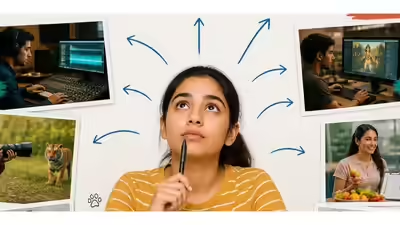

As students wait for their Class 12 results, for many, this period brings uncertainty, as the next step depends not just on scores, but also on career choices that will shape long-term goals. For years, options after school were seen as limited. Engineering, medicine, CA, law and government exams dominated the conversation, and most students were expected to choose from these familiar paths. In many cases, decisions were influenced more by social expectations than by individual interests or strengths. However, this approach is gradually changing. With the expansion of higher education and new industries, students today are no longer restricted to a few conventional careers. New-age courses, skill-based programmes and interdisciplinary degrees have opened up multiple pathways across sectors. At the same time, access to information has also improved. Students are now more aware of emerging fields, global career trends and alternative education models. This has made career planning more flexible, but also more complex, as the number of choices has increased significantly. As a result, waiting for class 12 reuslts is not just a period of stagnancy. It is also a phase where students should evaluate their interests, understand available options and make informed decision about their future.
Design and creative careers
Design has emerged as a structured and professional career path. Students can pursue undergraduate degrees such as BDes (Bachelor of Design), BFTech or specialised diplomas in areas like fashion design, product design, animation, game design and UI/UX design. Admissions to top institutes are usually through entrance exams such as NID DAT, NIFT Entrance Exam and UCEED. In India, institutes like the National Institute of Design and National Institute of Fashion Technology are among the most recognised. Private institutes such as MIT Institute of Design and Srishti Manipal Institute also offer similar programmes. Students also have strong study abroad options in countries like the UK, US and Italy, where design schools such as Parsons, Central Saint Martins and Politecnico di Milano are well known. Career opportunities include roles in design studios, tech companies, advertising agencies and startups. Entry-level salaries in India may start around Rs 3–6 lakh per annum, but experienced designers, especially in UI/UX and product design, can earn significantly higher, including international opportunities.
Behavioural sciences
Psychology and behavioural sciences are becoming important due to growing awareness around mental health. Students can start with a BA or BSc in Psychology, followed by a master’s degree for specialisation in clinical psychology, counselling, or organisational behaviour.Admissions in India are mainly through CUET or university-level entrance tests. Universities such as Delhi University, Christ University and TISS offer recognised programmes. For those aiming to practise as licensed psychologists, higher studies like MPhil or professional certification are required.Study abroad options are also strong, especially in countries like Canada, Australia and the UK, where psychology degrees are widely offered with research exposure.Career options include counselling, therapy, HR roles, research and teaching. Starting salaries may range from Rs 3–5 lakh per annum, but with specialisation and experience, earnings can increase significantly, especially in private practice or corporate roles.
Sports and fitness
Careers in sports are no longer limited to becoming an athlete. Students can pursue degrees such as BSc in Sports Science, Bachelor of Physical Education (BPEd), or courses in sports management, physiotherapy and fitness training. Admissions vary, with some institutes conducting entrance tests or trials. Institutes like the Netaji Subhas National Institute of Sports and Lakshmibai National Institute of Physical Education offer structured courses. Private universities also provide sports management programmes. Students can also explore study abroad options in countries like Australia, the UK and the US, where sports science and physiotherapy programmes are advanced. Career roles include coaches, fitness trainers, sports analysts, physiotherapists and sports managers. Earnings vary widely depending on expertise, but experienced professionals, especially in elite sports or international roles, can earn well.
Performing arts
Fields such as filmmaking, acting, music production and sound engineering are now supported by formal education. Students can pursue degrees or diplomas in film studies, performing arts or sound engineering, with admissions through institute-level tests or auditions. Institutes like the Film and Television Institute of India and Satyajit Ray Film and Television Institute are among the top government institutes. Private film schools and media academies also offer specialised courses. Study abroad is a major option in this field, with countries like the US and UK offering advanced training in filmmaking and music production. Careers are often project-based, with roles in films, OTT platforms, advertising and media production. Earnings can be unpredictable at the start, but skilled professionals can earn significantly over time.
Vocational and skill-based courses
Vocational education focuses on practical skills and shorter-duration training. Students can pursue certifications or diplomas in digital marketing, graphic design, photography, culinary arts and content creation. These courses are often offered by private institutes or online platforms, with direct admission. Hospitality institutes and culinary schools also offer diploma and degree programmes for students interested in becoming chefs or working in the food industry. Study abroad options are available in hospitality and culinary arts, especially in countries like Switzerland, France and Australia. These careers allow early entry into the workforce. Earnings depend heavily on skill and experience. For example, chefs, photographers and digital marketers can scale their income through freelancing, entrepreneurship or international opportunities.
Social sector and development studies
Students interested in social impact can pursue degrees such as Bachelor of Social Work (BSW) or programmes in development studies and public policy. Admissions are through CUET or institute-level processes. Institutes like Tata Institute of Social Sciences and Delhi University offer recognised programmes. Study abroad options are also available, particularly in development studies and international relations. Career options include working with NGOs, international organisations, research institutes and policy think tanks. Salaries in the social sector may start lower compared to corporate roles, but increase with experience, especially in international organisations.With a wide range of options available, the decision after Class 12 should be based on a combination of interest, ability and long-term goals. Students should also consider factors such as course structure, cost, entrance exams and career opportunities before making a choice. The shift in career trends shows that success is no longer limited to a few traditional professions. As industries evolve, new roles continue to emerge, offering students multiple pathways to build meaningful and sustainable careers.