



🌕 Wolf Supermoon 2026: First of 13 Full Moons Lights Up January Skies
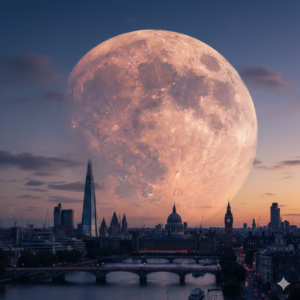

The night sky is set to deliver a stunning celestial show as the Wolf Supermoon rises on 3 January 2026, marking the first full Moon of the year and the beginning of a rare astronomical cycle featuring 13 full Moons instead of the usual 12.
As post-holiday lights come down and winter settles in, this bright and oversized Moon offers a perfect reason to step outside and look up. If weather conditions cooperate, skywatchers across the UK will be treated to one of the brightest and largest Moons of the year.
🌕 What Is the Wolf Supermoon?
The Wolf Moon is the traditional name given to January’s full Moon. In 2026, it becomes even more special because it coincides with a supermoon—a moment when the Moon appears noticeably larger and brighter than usual.
This will be the fourth supermoon in a row, following:
•October’s Harvest Moon
•November’s Beaver Moon •December’s Cold Moon
Having four consecutive supermoons is uncommon, making January’s Wolf Moon particularly exciting for astronomy lovers and casual viewers alike.
🌌 Why Is It Called a “Supermoon”?
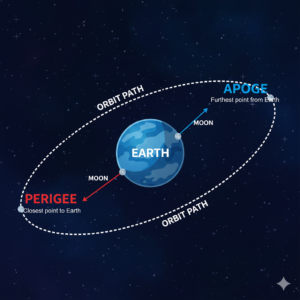
The Moon doesn’t orbit Earth in a perfect circle. Instead, it follows an elliptical path, meaning its distance from Earth changes throughout the month.
•Perigee: When the Moon is closest to Earth (~220,000 miles)
•Apogee: When it is farthest away (~250,000 miles)
When a full Moon occurs near perigee, it’s called a supermoon. At this point, the Moon can appear:
Up to 14% larger
Around 30% brighter
While supermoons happen three to four times a year, four in succession is rare, making this event extra noteworthy.
🐺 Why Is January’s Full Moon Called the Wolf Moon?
The name “Wolf Moon” dates back to ancient times, long before modern calendars existed. Full Moon names helped communities track seasons and natural cycles.
January’s Moon earned its name because:
•Wolves were often heard howling outside villages
•Food was scarce during deep winter
•Nights were long and cold
Other traditional Moon names include the Hunter Moon, Flower Moon, and Harvest Moon, each linked to seasonal events.
👉 Learn more about traditional Moon names on NASA’s lunar guide (external link).
⏰ When Can You See the Wolf Supermoon in the UK?
The Wolf Supermoon will rise on Saturday, 3 January 2026, reaching its peak fullness at 10:03 GMT.
However, the Moon looks most dramatic near the horizon, shortly after moonrise. Approximate moonrise times across the UK include:
•Aberdeen – 15:06
•Belfast – 15:48
•Oxford – 15:51
•Swansea – 16:03
📸 Tip: This is the best time for photography due to the Moon illusion, which makes it appear even larger near the horizon.
🌙 Why 2026 Is a Rare Year for Moon Watchers
2026 is special because it will feature:
•13 full Moons
•Two full Moons in May (a Blue Moon)
•Additional supermoons in November and December
A Blue Moon occurs when two full Moons fall within the same calendar month—an event that happens only once every few years. This rarity is the origin of the phrase “once in a blue Moon.”
🌠 Bonus Sky Event: Quadrantids Meteor Shower
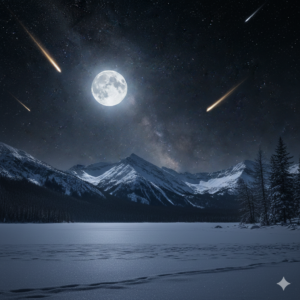
As if the Wolf Supermoon weren’t enough, the Quadrantids meteor shower will also peak on 3–4 January.
Under clear skies, viewers may spot:
•Bright, fast meteors
•Up to 40 meteors per hour at peak
📌 Best viewing: After midnight, away from city lights.
☁️ Will the Skies Be Clear?
Weather forecasts suggest:
•Mostly clear skies across much of the UK
•More cloud cover in Northern Scotland, eastern England, and west Wales
•Ongoing risk of snow showers in some regions
🌬️ Expect strong northerly winds and temperatures dropping below freezing, so dress warmly if heading outdoors.
🔭 How to Get the Best View of the Wolf Supermoon
•Find an open area with a clear horizon
•Avoid city lights if possible
•Use binoculars or a telescope for surface detail
•A smartphone with night mode works surprisingly well for photos
❓ FAQs (Great for Google Featured Snippets)
Q1. What date is the Wolf Supermoon in 2026?
👉 3 January 2026.
Q2. Why does the Moon look bigger during a supermoon?
👉 Because it is closer to Earth at perigee.
Q3. How many supermoons are there in 2026?
👉 At least four, including November and December.
Q4. Is the Wolf Moon rare?
👉 The name isn’t rare, but four supermoons in a row is unusual.