
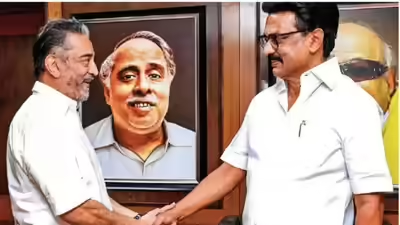
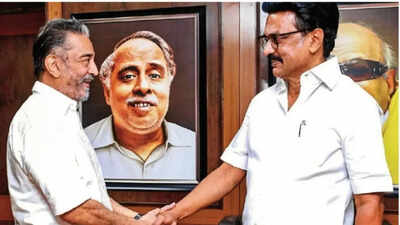
Last month, when Kamal Haasan drove into Anna Arivalayam, the DMK headquarters in Chennai, to accept the Rajya Sabha nomination from CM M K Stalin, it marked the end of the road for the Makkal Needhi Maiam (MNM) founder’s promise to provide an alternative to the two Dravidian parties in Tamil Nadu.Haasan launched MNM in Feb 2018, seeking to distil the anger against the establishment. MNM’s first political promo ahead of 2019 Lok Sabha elections showed the actor breaking a TV set that’s beaming a speech, ostensibly by Stalin. Cut to 2026 and, having accepted a Rajya Sabha nomination, Haasan “magnanimously” surrendered the three assembly seats DMK had offered to MNM as an alliance offering.Why did Haasan, who redefined success in movies, fail to live up to his promise as a politician? The mistakes, probably, started early. MNM, true to its name (‘Maiam’ means centre), sought to be a centrist force, representing diverse sections of society. That positioning itself was seen as lacking credibility, since Haasan was known for his leftist views much before his political entry. Being at the centre of the political discourse also smacked of political ambivalence.In the poll arena, MNM met with successive electoral setbacks. In 2019 Lok Sabha polls, it contested 37 seats and drew a blank, with a vote share of 3.7%. In 2021 assembly elections, it fielded candidates in 154 seats, won nothing, and saw its vote share dip to 2.5%. In neighbouring Puducherry, it got just 1.8% votes. Ahead of the 2024 general elections, MNM joined the DMK-led alliance.Following the demise of influential leaders such as Jayalalithaa and M Karunanidhi, many saw a new political space in Tamil Nadu, which film personalities like Haasan and Rajinikanth could potentially fill. While Haasan took the plunge, Rajinikanth shelved his political plans in late 2020, citing health concerns.Haasan’s core team comprised people from diverse professional backgrounds — IAS officer Santhosh Babu, retired IPS officer A G Maurya, businessman R Mahendran, entrepreneur C K Kumaravel, social worker Kameela Nasser, actordirector Sripriya, and writer Suka. Though notable in their respective fields, they were all political novices, and Haasan failed to attract veterans from other parties.Anusha Ravi, a lawyer who was MNM propaganda secretary, says she joined the party attracted by Haasan’s call for change. “But, soon, he lost his conviction and I felt demotivated. Haasan is passionate about cinema, but not politics,” says Ravi, who joined BJP in 2024.Some political analysts feel Haasan lacked a coherent political strategy. “MNM has had a weak organisational structure and limited engagement with people,” says political commentator Aazhi Senthilnathan. “Haasan’s appeal remains largely confined to urban voters. Several key members exited the party after the 2019 debacle, some joining other parties like DMK.”Political analyst Priyan Srinivasan says Haasan was unsure of how to deal with setbacks. “Electoral defeat is normal; one must have a plan to take the party forward,” he says. “Look at Naam Tamilar Katchi. It faced several defeats, but its leader Seeman is least frustrated and keeps the party relevant.”Viduthalai Chiruthaigal Katchi (VCK) general secretary D Ravikumar says Haasan’s electoral loss to Vanathi Srinivasan by a narrow margin in Coimbatore in 2019 was a turning point. “Had he won, his political career would have been different. Sustaining a political party requires patience, grassroots work, and long-term commitment,” says Ravikumar, who terms Haasan’s migration to DMK fold “pragmatic and regressive”.In cinema, Haasan, called ‘Sakalakala Vallavan (master of all arts)’ is known for displaying intellectual depth and creative assertiveness. However, many of his works struggled to resonate with rural audiences, as his ideas were sometimes ahead of their time. Mentored by legendary director K Balachander, Haasan rose to become one of South India’s most celebrated actors.Yet, the transition from cinema to politics brings a different set of challenges, where individual brilliance must give way to collective leadership and organisational strength.Haasan is not the first big star to fail in politics. Legendary actor Sivaji Ganesan tried his luck with DMK and Congress, before founding Thamizhaga Munnetra Munnani in 1988. After failing to make a mark in the 1989 elections, it merged with Janata Dal. For Tamil Nadu’s latest film-to-politics crossover star TVK leader Vijay, Haasan’s journey holds several lessons.CROSSOVER STARSM G Ramachandran | The actor joined DMK in 1953 after leaving Congress. He was appointed party treasurer in 1969. In 1972, after differences within saw him expelled from DMK, MGR floated his party, ADMK. He would serve as a two-term CM, remaining in the saddle for 10 years.J Jayalalithaa | She joined ADMK in 1982 and quickly rose through the ranks to become its propaganda secretary by 1983. Known as ‘Puratchi Thalaivi’, or ‘revolutionary leader’, she was a five-time CM and was an ADMK colossus who has been the longest-serving general secretary of the party.Sivaji Ganesan | Founded Thamizhaga Munnetra Munnani party in 1988 after leaving Congress. But the party failed to win seats in 1989 polls, leading him to briefly join Janata Dal before retiring from politics.Vijayakanth | Founded DMDK in 2005 and served as a two-time MLA from the party. DMDK emerged as the second-largest party in the 2011 assembly elections and Vijayakanth went on to become leader of the opposition in the Tamil Nadu assembly from 2011 to 2016.R Sarath Kumar | The actor founded All India Samathuva Makkal Katchi (AISMK) in 2007. After leading the party for over 16 years, he merged it with BJP in 2024, citing the need for stronger collective action and ideological alignment with PM Modi.