
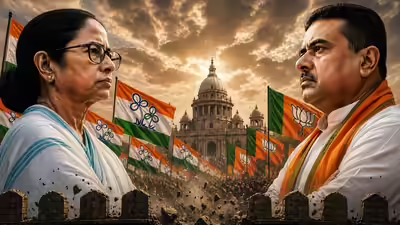
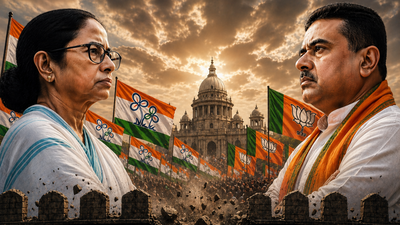
NEW DELHI: West Bengal is marching into Phase 2 of its assembly elections with the political temperature rising as sharply as the summer heat. After an unprecedented 93.2 per cent voter turnout in Phase 1, despite scattered violence, the state is now set for what could be the defining chapter in the battle for the country’s second-largest assembly.The record turnout has energised both the ruling Trinamool Congress and the Bharatiya Janata Party, each claiming that the people’s enthusiasm points to momentum in their favour.

As Bengal prepares to vote across 142 seats on April 29, the spotlight is firmly on Bhabanipur, long-incumbent chief minister Mamata Banerjee’s bastion, where symbolism, prestige, and political power are all on the line.
High-decibel campaign, high political stakes
The campaign for this crucial phase ended on April 27 at 5 pm, but not before Bengal witnessed days of relentless political theatre. Helicopters hovered across the skyline, roadshows packed city streets, and fiery speeches kept the battle alive till the very last moment.For Mamata Banerjee, this is not merely another election but a fight to protect the fortress she has built over the past 15 years. Positioned as one of Prime Minister Narendra Modi’s fiercest critics, and also someone who strongly counters BJP’s national hold, Mamata has cast this election as a battle for Bengal’s identity and Didi’s push for “maa, maati, manush”.The BJP, however, has mounted perhaps its most determined challenge yet. With BJP’s top star Prime Minister Narendra Modi fronting the campaign and “Chanakya” Amit Shah working the electoral machinery, the saffron party has pushed the promise of “poribortan”, change, hoping to convert its rise in Bengal into political power for the first time ever.Mamata has countered that challenge with a familiar but effective political line, branding the BJP as “bohiragata” or outsiders, arguing that Bengal cannot be politically dictated to by Delhi.“Remember this — you do not have the capability to defeat us. We fight against injustice; we fight for our rights. I was born in Bengal and will breathe my last here. Once we win Bengal, I will take the fight to Delhi and unite all Opposition parties. I do not seek power; I seek the complete dismantling of the BJP in Delhi. While their defeat in Bengal is certain, the BJP must be removed from Delhi as well, mark my words,” she added.
The opposition’s moment, but a divided one
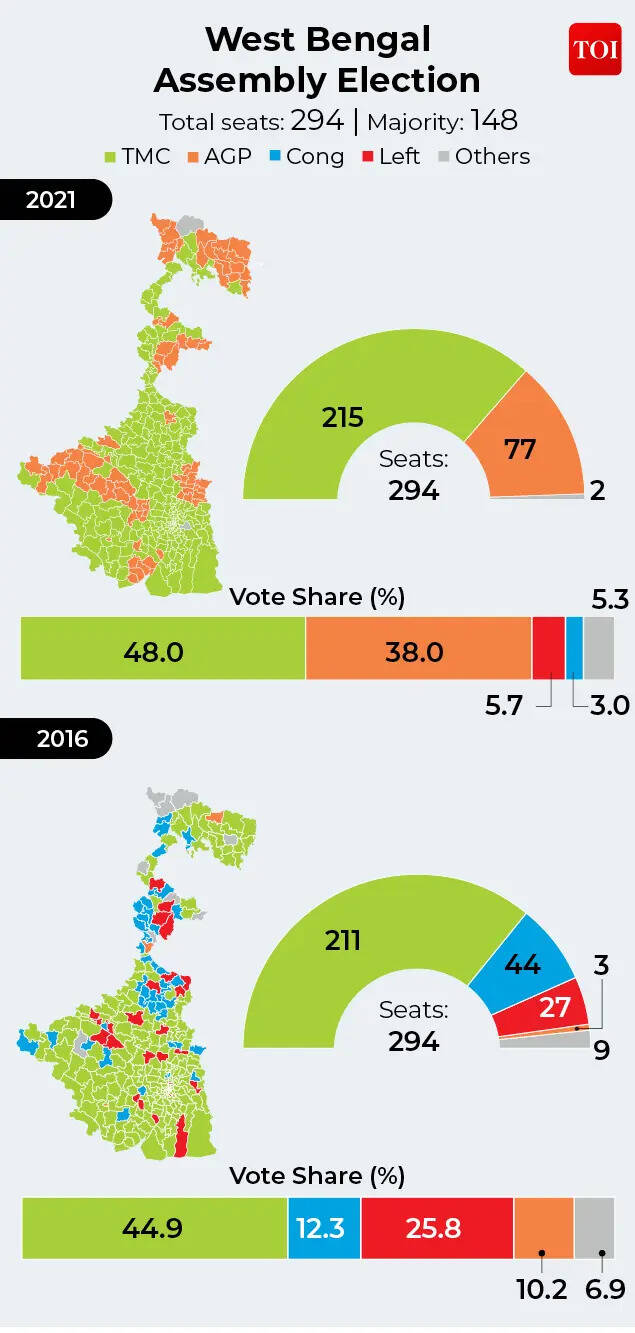
The BJP enters this phase as the main opposition force, holding 77 seats in the current assembly and eyeing a larger breakthrough in the state’s urban and semi-urban belts.Yet the anti-TMC space remains fractured. Congress and the Left, once Bengal’s dominant political forces, continue to struggle for relevance after their 2021 collapse. Though aligned with the INDIA bloc nationally, in Bengal they are contesting directly against Mamata’s 15-year-old regime.There are also smaller challengers trying to carve out space. Expelled TMC leader Humayun Kabir, now leading AJUP in alliance with Asaduddin Owaisi’s AIMIM, is adding another layer to an already crowded battlefield.Still, for all the multiple players, the political script in Bengal remains centred around the TMC-BJP face-off.
The Bhabanipur battle: Mamata’s prestige on the line
If Phase 2 has one epicentre, it is Bhabanipur.The constituency is not just another seat on the electoral map; it is Mamata Banerjee’s political home ground, the heart of her urban stronghold, and the symbol of her authority in Kolkata. Since 2011, Bhabanipur has stood firmly with Mamata, becoming synonymous with her political identity.But this time, Bhabanipur carries a sharper edge because standing across from her is Suvendu Adhikari, the man who delivered Mamata her most embarrassing defeat in Nandigram in the 2021 polls.That contest transformed Didi’s former aide Suvendu into the BJP’s “giant-killer” in Bengal politics. Now, he is attempting an even bigger political strike by challenging Mamata in her own citadel.The contest is also important because of its historical baggage. Bhabanipur was once represented by former chief minister Siddharth Shankar Ray from 1972 to 77, the last time Congress saw power in the state.A victory for Mamata would reaffirm her hold over Kolkata; a strong BJP showing would send a powerful message that no TMC bastion is beyond challenge.
Margins, voter rolls and a tightening contest
The Bhabanipur contest has become even more politically charged after the Election Commission’s special intensive revision (SIR) of voter rolls.Mamata has alleged that nearly 51,000 names, around 21 per cent of the electorate, have been deleted, including a major number of Muslim voters, a bloc traditionally seen as supportive of the TMC.


In 2021, Didi won the Bhabanipur bypoll by around 58,000 votes. With such large-scale deletions now in focus, the contest is being framed as one where margins may matter more than ever.That has allowed the TMC to sharpen its narrative that the election is not just about power but also about protecting voter rights, while the BJP has continued to insist that the contest is about accountability and change.
Didi’s southern fortress faces its toughest test
Beyond Bhabanipur, the broader electoral map in phase 2 heavily favours the TMC on paper.Most of the 142 constituencies voting in this round are located in South Bengal and the greater Kolkata belt, regions that have long formed the backbone of Didi’s dominance. In the 2021 election, the TMC won 123 of these 142 seats, while the BJP managed 18 and the Left alliance was left with just one.That arithmetic makes this phase crucial.For Mamata, a repeat performance here is essential to keep her grip on power intact. For the BJP, any meaningful gains in this belt would signal that the political landscape is shifting.More than 3.21 crore voters are eligible in this phase, with polling to take place across 41,001 stations under webcasting surveillance. The districts in play include Kolkata North and South, Howrah, Nadia, North and South 24 Parganas, Hooghly and Purba Bardhaman, all politically important, demographically diverse, and electorally decisive.
Heavyweights on the battlefield
The second phase will also determine the fate of some of the big guns in Bengal.For the TMC, apart from Mamata Banerjee, key leaders such as Kokata mayor Firhad Hakim, Chandrima Bhattacharya, Shashi Panja, Aroop Biswas, Bratya Basu and Sujit Basu are in the fray.The BJP has responded with a line-up of its own, fielding Swapan Dasgupta, Rupa Ganguly and other prominent faces.One of the BJP’s most symbolic moves has been fielding the mother of the RG Kar rape-murder victim from Panihati, turning the campaign into a direct emotional challenge to Mamata over law and order and incidents such as Sandeshkhali and Murshidabad.This has given the BJP an emotive campaign plank, while forcing the TMC to defend not just governance but its moral credibility.
Campaigning with culture and confrontation
Like every Bengal election, this campaign blended hard politics with cultural imagery.Prime Minister Narendra Modi’s stop for jhalmuri after a rally in Jhargram was more than a casual moment; it was carefully crafted symbolism aimed at connecting with Bengali sentiment. The TMC, in turn, invoked Bengal’s “maachh bhaat” identity to portray the BJP as culturally disconnected and politically intrusive.In a letter to Bengal voters, PM Modi sought to strike an emotional chord, writing, “Throughout this election campaign, I have experienced a unique energy in Bengal. Despite the scorching heat and the multitude of rallies, I did not feel even the slightest fatigue during this election in Bengal. These rallies and roadshows have felt like a pilgrimage to me. As I moved amongst the devotees of Maa Kali, it seemed as though Maa Kali herself was continuously infusing me with fresh energy,” and added, “During this election, I observed that for a ‘Developed Bengal’ (Viksit Bengal), the people seek an open field–a level playing ground–to pursue their aspirations. Our daughters desire an open sky–the freedom to soar–and, above all, they seek security. Every citizen, every family, is now determined to move forward with a singular resolve. There has been enough fear; what is needed now is trust–and what is needed now is the BJP.”

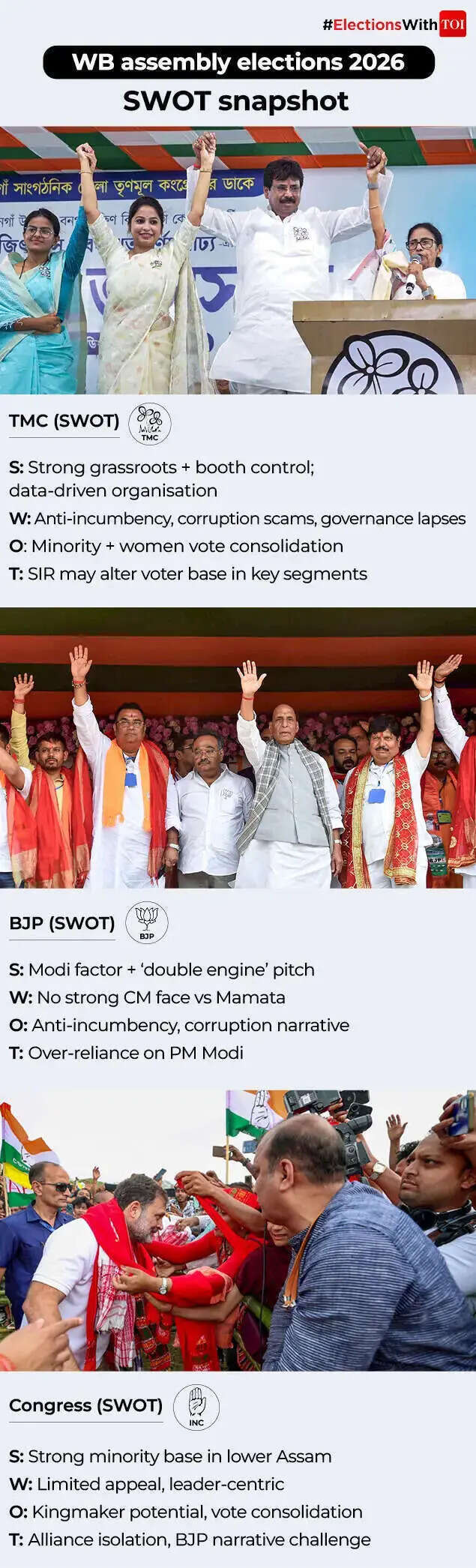
Mamata responded with equal force, framing the election as a fight to defend Bengal’s dignity. She said, “Across Chowrangee, Bhabanipur, Jadavpur and Tollyganj, I saw people turn out with clear intent, determined, united, and ready to defend Bengal, its identity, and its future. Those who believe they can run Bengal from Delhi, dictate its politics, divide its people, and distort its culture are deeply mistaken. This land has a long memory and a stronger spine,” and further added, “Those sitting in Delhi, plotting to snatch Bengal’s rights and impose their agenda, should understand it clearly that the people of Bengal are watching, and they will respond through their vote. Every attempt to undermine Bengal will be met with a decisive democratic pushback. This election is about resisting a systematic attempt to weaken Bengal and control it.”
The turnout war
Even before phase 2 begins, the battle over perception has intensified around phase 1 turnout.The BJP has projected the 93.2 per cent turnout as an undercurrent of anti-incumbency, with Amit Shah declaring that “the sun has set for Trinamool Congress in West Bengal.”The TMC, unsurprisingly, sees the same numbers differently.Mamata Banerjee argued, “Do you know why voter turnout is so high even after deletion of so many names? It is because people know that this election is a fight to safeguard their rights. Because after this, they (BJP) will implement the National Register of Citizens (NRC).” Abhishek Banerjee reinforced the point, saying, “I am not a political astrologer. Whenever I have made predictions on political results, it has clicked. In the first phase, we have hit a century. There is panic in the BJP camp. They are calling journalists and asking them to run the narrative that the BJP has done well in the first phase and is cruising ahead.”In Bengal, turnout has always meant more than just numbers; it becomes a political message, interpreted differently by each camp.
The decisive round
As Bengal moves into phase 2, the election enters its most consequential moment.For Mamata, this is a battle to defend not just seats but the political and emotional ground on which her leadership stands. For the BJP, this is the clearest opening yet to breach Bengal’s strongest political fortress.The turnout has been historic, the campaigning relentless, and the rhetoric intense. Now, with 142 seats at stake and Bhabanipur at the centre of the storm, Phase 2 is poised to decide not only who wins Bengal but what political story Bengal tells next. The results will be out on May 4.