
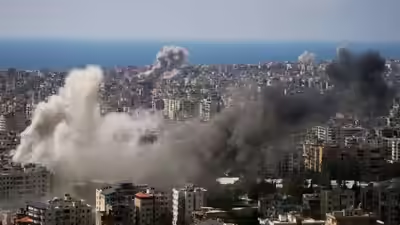
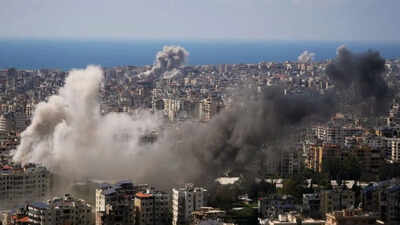
Driving the newsBillionaire investor Ray Dalio says the world has already slipped into a sprawling, multi-front war – one that resembles the early stages of past global conflicts but lacks a formal start date.Writing in his Principled Perspectives Substack, Dalio argues the ongoing US-Israel-Iran conflict is not an isolated crisis but part of a much broader global struggle.“For today, that is most importantly that the US-Israel-Iran war is just part of a world war that we are in and that isn’t going to end anytime soon,” Dalio writes in his post. He adds he is not describing a desired future but “the picture that I believe to be true based on what I have learned and what the indicators that I use to objectively see things now suggest is true.”Dalio’s warning lands at a moment when policymakers and investors remain focused on near-term risks – inflation, interest rates, and regional conflicts – rather than systemic shifts. Why it mattersDalio’s core message: markets and governments may be dangerously underestimating the scale and duration of current global tensions.He argues today’s conflicts collectively meet the definition of a “classic world war” – a network of interconnected military and non-military confrontations involving major powers.“Together, these conflicts make up a very classic world war that is analogous to past ‘world wars,’” he writes, emphasizing that earlier global wars also “slipped into without any clear start dates or declarations of war.”This framing suggests:
- Current instability is not temporary
- Geopolitical risk is structural, not cyclical
- Economic and financial systems could face prolonged disruption
The big pictureDalio situates today’s turmoil within what he calls the “Big Cycle” – a historical pattern of rising and declining empires, shifting monetary systems, and changing world orders.Drawing on 500 years of history, he compares the current period to:
- 1913–14, before World War I
- 1938–39, before World War II
“I have many indicators suggesting that we are in the part of the Big Cycle when the monetary order, some domestic political orders, and the geopolitical world order are breaking down,” he writes.“These indicators suggest that we are in a transition stage from the pre-fighting stage to the fighting stage.”In Dalio’s framework, economic stress, internal political divisions, and external conflict tend to reinforce each other – accelerating systemic breakdown.Zoom in: A ‘world war’ without a declarationDalio identifies multiple overlapping conflict zones forming a global web:
- The “Russia-Ukraine-Europe-US war”
- The “Israel-Gaza-Lebanon-Syria war”
- Yemen-Sudan-Saudi Arabia-UAE tensions
- The emerging “US-Israel-GCC-Iran war”
Alongside these are non-kinetic battles over:
- Trade
- Technology
- Capital flows
- Global influence
These, he says, involve “most countries,” creating a de facto global conflict environment.The key distinction: unlike past world wars, there is no single trigger event – just a gradual escalation across multiple fronts.Between the lines: Two blocs are formingDalio argues the world is increasingly dividing into two opposing power blocs.On one side:ChinaRussiaIranNorth KoreaCubaOn the other:United StatesUkraine and most of EuropeIsraelGulf Cooperation Council (GCC) statesJapan and Australia“It is quite easy to see objectively how the sides are lining up,” Dalio writes, citing treaties, UN votes, and policy alignment.This alignment, he suggests, is already reshaping economic outcomes.For example, he challenges the assumption that China is highly vulnerable to disruptions in Middle Eastern oil supply.“China’s mutually supportive relationship with Iran will probably allow oil going to China to get through, and China’s relationship with Russia will ensure that China will get oil from Russia,” he writes.He adds that China’s domestic energy capacity and reserves further strengthen its position, noting it has “a lot of other energy (coal and solar) and a huge inventory of oil (about 90-120 days’ usage).“China consumes 80-90% of Iran’s oil output, which adds to the power of its relationship with Iran,” he writes. What they are saying: A strained United StatesDalio portrays the United States as still powerful but increasingly overstretched.He points to America’s global military footprint:“750-800 military bases in 70-80 countries (by the way, China only has 1)”He calls these “expensive vulnerabilities all over the world.”“It is also obvious that overextended powers cannot successfully fight wars on two or more fronts,” Dalio writes.He argues how the US handles the Iran conflict – including how much it spends and how effectively it supports allies – will influence global perceptions of its strength.“I assure you that that type of thinking is now happening among world leaders and that what is now happening has happened many times before in similar parts of the Big Cycle,” he writes. A shift to ‘might-is-right’Dalio’s most sweeping claim is that the global system has already transformed.“I believe that it is important to see that: the world order has changed from a multilateral rules-based world order led by the dominant US power and its allies (e.g., the G7) to a might-is-right world order with no single dominant power enforcing order, which means that we can expect more fighting,” he writes.This shift implies:
- More frequent conflicts
- Weaker global institutions
- Greater reliance on military and economic power
He also notes rising nuclear concerns, citing “less confidence among some countries that the US will defend them” and “more talk among countries’ senior policy makers about obtaining nuclear weapons.”Endurance over strengthDalio argues wars are ultimately decided not by power, but by resilience.“As history has shown, the most reliable indicator of which country is likely to win is not which is most powerful; it is which can endure the most pain the longest,” he writes.He contrasts US expectations of quick resolution with adversaries that may be prepared for prolonged hardship.“While the United States appears to be the most powerful country in the world, it is also the most overextended major power and the weakest at withstanding pain over a long period of time,” Dalio concludes.What’s nextDalio stops short of predicting inevitable global war – but warns the trajectory is dangerous.“To reiterate, I’m not saying that things will definitely progress further along this cycle to an all-out world war,” he writes. “I don’t know what’s going to happen, and I still hope for a peaceful world built on win-win relationships rather than damaged by lose-lose ones.”Still, he cautions that unresolved conflicts tend to escalate.“At this stage of the Big Cycle, just before major wars, circumstances like the inability to resolve irreconcilable disputes with compromises typically drive one stage in the cycle unavoidably to the next until there is a violent resolution,” he writes.