

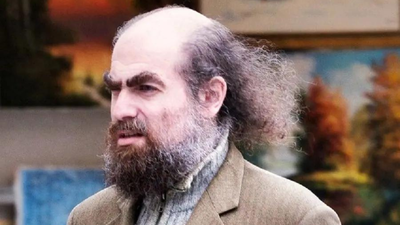
In a world where scientific breakthroughs often bring fame, wealth, and global recognition, Grigori Perelman chose a completely different path. The Russian mathematician stunned the academic world after solving the Poincare Conjecture, one of the most difficult unsolved problems in mathematics that had remained unanswered for nearly a century. But what made Perelman even more fascinating was what happened next. He refused the prestigious Fields Medal in 2006 and later rejected a $1 million Millennium Prize from the Clay Mathematics Institute, walking away from international fame and becoming one of modern mathematics’ most mysterious figures.
The hundred year old problem solved by Grigori Perelman
The Poincaré Conjecture was proposed in 1904 by French mathematician Henri Poincaré and quickly became one of topology’s most important unsolved questions.Topology is often described as the study of shapes and spaces. The conjecture focused on understanding the fundamental structure of three-dimensional spaces and whether certain shapes could be mathematically transformed into a sphere.For decades, the problem resisted some of the world’s greatest mathematicians. Its difficulty became legendary within academic circles, and solving it was considered one of the biggest possible achievements in mathematics.In 2000, the Clay Mathematics Institute included the conjecture among its seven Millennium Prize Problems, each carrying a reward of $1 million for a correct solution.


How Perelman solved the impossible problem
Perelman built upon earlier research developed by mathematician Richard S. Hamilton, who had introduced a geometric method known as Ricci flow.Ricci flow can be imagined as a process that gradually smooths out irregular geometric shapes over time. Hamilton’s work created the foundation for attacking the Poincaré Conjecture, but several major technical obstacles still remained unsolved.Between 2002 and 2003, Perelman published a series of papers online through the arXiv preprint server instead of traditional academic journals. In those papers, he solved the remaining problems and provided a proof for the conjecture.The mathematics community initially reacted with caution because the proof was highly complex. Teams of experts spent years reviewing every detail before eventually confirming that Perelman’s work was correct.His proof was later recognised as one of the greatest mathematical achievements of the modern era.
Rejecting the Fields Medal
In 2006, Perelman was awarded the Fields Medal, often considered the highest honour in mathematics and frequently compared to a Nobel Prize for the field.But Perelman refused to accept it.He did not attend the International Congress of Mathematicians in Madrid, becoming the first person in history to decline the Fields Medal.According to reports and interviews, Perelman felt uncomfortable with the culture of fame surrounding academic success. He also believed that greater recognition should have been given to Richard Hamilton for developing the original ideas behind the proof.His refusal shocked the mathematics world, where such honours are usually considered career-defining achievements.
Turning down the $1 million Millennium Prize
Perelman surprised the world again in 2010 when he rejected the $1 million Millennium Prize awarded by the Clay Mathematics Institute.The institute had officially recognised his proof of the Poincaré Conjecture after years of verification, making him the first and so far only mathematician to solve one of the seven Millennium Prize Problems.Yet Perelman refused the money.Reports at the time suggested he no longer wanted public attention and had become deeply frustrated with academic politics. Some accounts also indicated that he disagreed with how credit for the discovery was distributed within the mathematics community.His rejection of both the Fields Medal and the million-dollar prize transformed him into an almost mythical figure far beyond academic mathematics.
Life away from fame and public attention
After his breakthrough, Perelman largely withdrew from public academic life. He reportedly resigned from the Steklov Institute of Mathematics in Saint Petersburg and avoided interviews and conferences.Over the years, only occasional reports emerged about his quiet life in Russia, often describing him travelling on public transport or shopping in ordinary neighbourhoods.Unlike many globally recognised scientists, Perelman showed little interest in building a public image, commercial opportunities, or celebrity status. His refusal to participate in the media attention surrounding his discovery only increased public fascination with him.Perelman’s story resonates far beyond mathematics because it challenges modern ideas about success and recognition.Most groundbreaking discoveries are closely associated with fame, awards, financial rewards, and institutional prestige. Perelman rejected nearly all of them despite solving one of the most important mathematical problems of the last century.To many people, he became a symbol of intellectual independence — someone driven purely by the desire to solve difficult problems rather than pursue wealth or public admiration.More than two decades after his proof transformed mathematics, Grigori Perelman remains one of the most enigmatic geniuses of the modern era.