
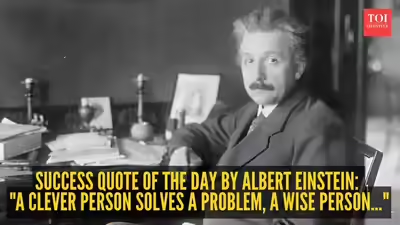
Most of us think of Albert Einstein as the guy with the wild hair who unlocked the secrets of the universe with his famous principle of mass-energy equivalence. But honestly, he was just as much a philosopher of “real life” as he was a physicist. One of his best—and most underrated—timeless wisdom that can help people succeed is this: “A clever person solves a problem. A wise person avoids it.”It sounds almost too simple, right? It almost sounds like he’s giving us permission to be lazy. But when you really peel back the layers, it’s a total game-changer for how we approach success. In a world that is obsessed with “grinding” and “hustling,” Einstein is basically telling us that the ultimate secret to success in life isn’t being the best fire-extinguisher—it’s making sure the fire never starts in the first place.
The “clever” hero vs. The “wise” ghost
Imagine you’re at work and a major project goes off the rails. The “clever” person is the one who stays until midnight, gives solutions to problems, and saves the day. Everyone cheers. They get a hit of dopamine, a pat on the back, and maybe a compliment like “Great job!” It’s a satisfying feeling, like cracking a difficult puzzle.But Einstein pushes us to look at the “wise” person—the one who saw the project’s flaws three weeks ago, adjusted the timeline, and set clear boundaries. This person isn’t staying late. In fact, they’re probably at home having dinner because they avoided the crisis entirely.The problem? Wisdom is invisible. As Daniel Kahneman explores in the book ‘Thinking, Fast and Slow’, our brains are wired to reward reactive fixes because they’re exciting. Solving a problem feels like a victory; avoiding one just feels like a normal Tuesday. But while cleverness saves the day, wisdom saves your sanity. Cleverness is about having quick wits; wisdom is about having proactive vision.
How this actually works in real life
This isn’t just corporate theory; it applies to every corner of your life.Your Career: A clever employee works 80 hours a week to manage a toxic boss. A wise employee reads the red flags during the interview and turns the job down. They avoid the burnout before it even has a chance to start.Your Relationships: Clever couples are great at “fixing” big fights with grand gestures and long apologies. Wise couples avoid the explosion altogether by having small, honest check-ins every day. They nip resentment in the bud before it turns into a blowout. Research from the Harvard Grant Study (which followed people for 80+ years!) shows that the happiest people aren’t the ones who survived the most drama—they’re the ones who prioritized prevention.Your Health: A clever fix for weight gain is a brutal, three-week juice fast. A wise habit is walking 20 minutes a day and not keeping junk food in the house. You’re avoiding the “problem” of poor health by making it harder to fail.
Why we’re addicted to the chaos
If avoiding problems is so much better, why don’t we do it more? Honestly, because modern life suffers from the “hustle” culture. Social media and “grind culture” have taught us that if you isn’t struggling, you isn’t working hard enough. We’ve turned stress into a status symbol.Einstein knew that cleverness is finite—you only have so much “reactive energy” before you burn out. Wisdom, however, scales. It’s why he eventually avoided petty academic debates to focus on the “big picture” of relativity. He knew that every minute spent fixing a small, avoidable mess was a minute stolen from his life’s work.
5 ways to stop playing firefighter
If you want to move from “clever” to “wise,” you have to change your default settings. Here is how to start:Audit the “Deltas”: Look at your life. What problems keep happening? If you’re always late, stop trying to drive faster (clever); start leaving ten minutes earlier (wise).The “Power of No”: Most of our problems come from things we said “yes” to when we should have stayed quiet. Avoid the drain by protecting your time upfront.The Sunday reset: Take 15 minutes to look at the week ahead. Where are the potential collisions? Adjust your course now.Find a Mentor: Wise people learn from their own mistakes; very wise people learn from other people’s mistakes. Find someone who has been where you’re going and ask them where the potholes are.Practice Minimalism: It’s simple math: the fewer commitments, objects, and “moving parts” you have in your life, the fewer things there are to break.
The payoff
Choosing to be wise doesn’t mean you’re being passive—it means you’re being strategic. By avoiding unnecessary drama and self-inflicted crises, you free up a massive amount of mental energy.Success isn’t about how many fires you can put out. It’s about building a life that doesn’t keep catching fire. So, look at your schedule for the coming week. What “problem” are you going to stop solving—and start avoiding instead?