
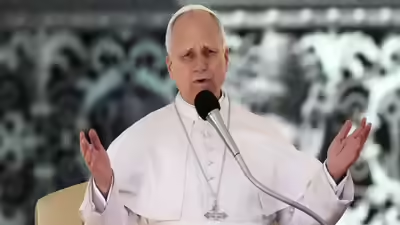
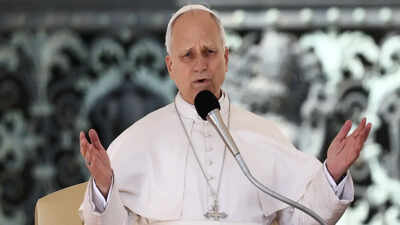
Pope Leo XIV called for the “disarming” of artificial intelligence in his first encyclical. He warned that the rapidly expanding technology risks fuelling warfare, exploitation and “new forms of slavery” unless it is placed firmly under human control.The manifesto, titled Magnifica Humanitas (“Magnificent Humanity”), was presented at the Vatican alongside AI experts, including the co-founder of US firm Anthropic.In the long-awaited document, the first US pope argued that the traditional “just war” theory was now “outdated” in an age of AI-directed weaponry and autonomous systems. Without naming US President Donald Trump, Leo criticised the use of religion and moral doctrine to justify conflict, saying: “No algorithm can make war morally acceptable.”The pope also declared that it was “not permissible to entrust lethal” decisions to technology, sounding the alarm over the growing use of artificial intelligence in military operations and surveillance systems.“Disarming AI means freeing it from the mentality of ‘armed’ competition,” Leo wrote, condemning what he described as “a race for ever more powerful algorithms and larger datasets, driven by the desire to secure geopolitical or commercial dominance”.“To disarm does not mean rejecting technology, but preventing it from dominating humanity,” he added.The Vatican released the encyclical as governments and technology companies race to expand AI systems expected by the United Nations to become a $4.8 trillion industry by 2033. Leo warned that the economic gains from AI were being concentrated “in the hands of a limited few” while workers behind the technology remained hidden from view.“Nothing in the world of AI is immaterial or magical,” the pope wrote, pointing to the “silent work of millions of people” involved in sustaining the industry, from content moderators exposed to disturbing material to children mining rare earth elements used in computing infrastructure.“They are scarred, injured and worn down so that computational flow may continue uninterruptedly,” he wrote.Leo said technological progress and efficiency could not justify “a chain of exploitation that remains deliberately hidden”, and called for stronger efforts to reduce AI’s environmental impact and “protect our common home”.The pope urged that artificial intelligence should remain “human-friendly”, accessible to all and open to public debate rather than controlled by geopolitical or commercial rivalries.The release of Magnifica Humanitas marks a major early intervention in Leo’s papacy, with the Vatican positioning AI ethics as a defining issue for the Catholic Church. The document was signed on May 15, the 135th anniversary of Pope Leo XIII’s landmark 1891 encyclical that shaped modern Catholic social teaching during the Industrial Revolution.The text draws on a broad range of cultural and philosophical references, from Plato and Beethoven’s Ninth Symphony to characters from JRR Tolkien’s The Lord of the Rings.The Vatican has been studying AI-related technologies for several years. In 2020, the Holy See launched the “Rome Appeal for an AI Ethic”, which urged that emerging technologies respect human dignity.Experts say Magnifica Humanitas could have an influence comparable to Pope Francis’s 2015 climate manifesto Laudato Si, which sparked political and civic debate around the world.