
HYDERABAD: In a state often celebrated for its rapid progress and development, a quieter, more uncomfortable reality persists behind closed doors. For thousands of households across Telangana, basic necessities—something as fundamental as a toilet, a tap, or a light switch—remain out of reach.One question remains: Can development truly be called progress if it leaves so many behind?Large sections of households in Telangana continue to lack access to basic amenities such as toilets, electricity and tap water, with the Socio-Economic, Educational, Employment, Political and Caste (SEEEPC) Survey-2024 highlighting deep and persistent inequalities across communities, particularly among Scheduled Tribes (STs).An analysis by the Independent Experts Working Group (IEWG) has revealed that, despite claims of development, fundamental living conditions remain uneven and continue to reflect social and economic backwardness. The report notes that indicators such as sanitation, electricity, water access and housing provide a more stable and reliable measure of deprivation than income or employment, which can fluctuate over time.

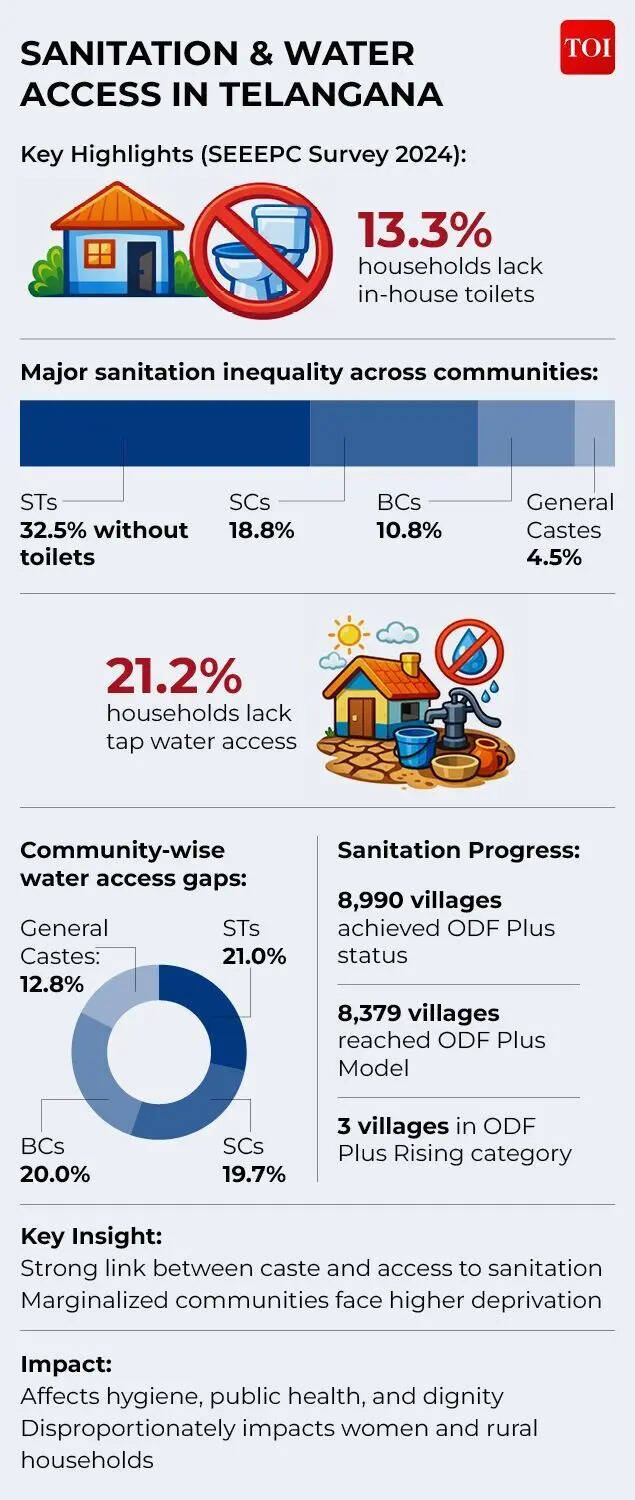
Sanitation inequality remains a major concernThe survey findings show that access to toilets remains highly uneven, with marginalised communities bearing the brunt. According to the report, 32.5% of ST households do not have toilets, compared to 18.8% among Scheduled Castes (SCs), 10.8% among Backward Classes (BCs) and 4.5% among other castes (OCs).“Lack of access to toilets is a fundamental indicator of development, backwardness, affecting hygiene, health, and personal dignity—especially for women and girls. In Telangana, 13.3 per cent of households reported having no toilet,” the Telangana Socio-Economic, Educational, Employment, Political and Caste (SEEEPC) Survey-2024 said.The report further stated, “18.8 per cent of SCs and a very high 32.5 per cent of STs reported no toilet facilities, exposing health and sanitation risks.” The lack of toilets often forces people into open defecation, increasing exposure to disease and posing safety concerns, especially for women and the elderly.Overall, more than 13% of households in Telangana reported having no toilet facilities, highlighting the continuing gap in sanitation access despite official claims.Electricity access still unevenElectricity access, considered essential for modern living, also shows disparities across caste groups. Around 11% of ST households do not have electricity connections, nearly double the state average of 5.8%.Among other groups, 8.3% of SCs, 4.7% of BCs and 2.7% of OCs lack electricity. As many as 6.56 lakh households reported not having electricity, reflecting infrastructure gaps.The absence of electricity limits access to education, healthcare, communication and livelihoods, the report noted, underlining how such gaps reinforce socio-economic disadvantage.Tap water access continues to lagDespite claims of universal coverage, access to tap water remains limited. The IEWG found that 29.2% of ST households do not have tap water connections, compared to 19% among SCs, 20% among BCs and 12.8% among OCs.At the state level, 21.2% of households reported lacking tap water access. The report noted that the absence of in-house piped water affects health and hygiene and places an added burden on women, who are often responsible for collecting water.Housing conditions reflect deeper inequalitiesHousing data further highlights disparities across communities. A large number of households, particularly among marginalised groups, live in small and overcrowded spaces.About 75% of ST households and 73% of SC households live in houses with fewer than two rooms. The figures are 63% for BCs and 47% for OCs. In comparison, only 17% of STs and 18% of SCs live in homes with three or more rooms, while the proportion is higher among BCs (28%) and OCs (42%).The findings point to overcrowding, lack of privacy and poor living conditions, which continue to affect quality of life.

‘Every backward caste not equally backward’The survey also highlights broader patterns of social inequality, noting that a majority of Telangana’s population remains disadvantaged. At the same time, it underlines that “every backward caste is not equally backward”.Based on the Caste Backwardness Index (CBI), SCs and STs are three times more backward than general castes, while BCs are 2.7 times more backward.Out of 242 castes analysed, 135 fall above the state average CBI, meaning they are more backward than the typical caste in Telangana. These include 69 BCs, 41 SCs and 25 STs, together accounting for 67% of the population.In contrast, all 18 general caste groups fall below the state average CBI and make up 12% of the population.

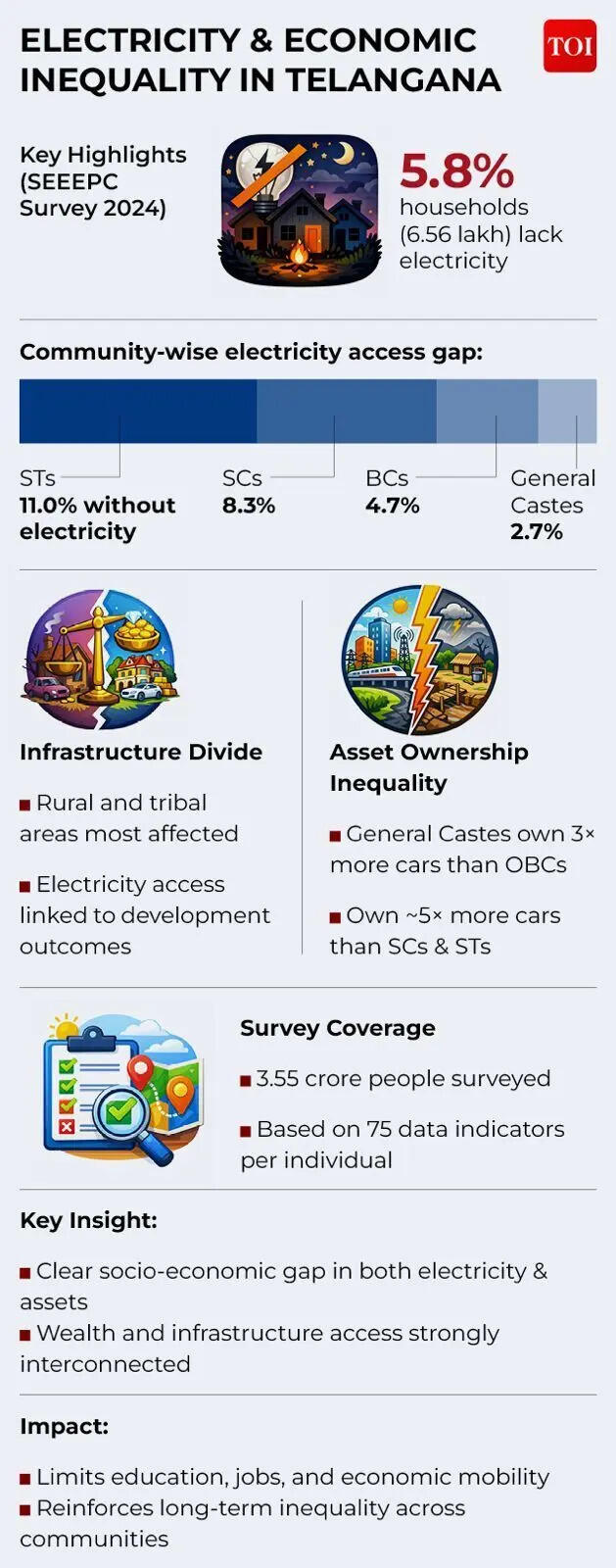
Workforce and living standards show disparityThe report also highlights inequality in employment and living standards. It found that 50% of SC individuals in the workforce are daily wage labourers, compared to one-tenth among general castes.Only 5% of private sector professionals are STs, while 30% belong to general castes. The report also notes that one-third of ST families live in homes without a toilet or tap water, compared to just 5% among general caste households.Additionally, households from other castes are more likely to own cars, with ownership levels three times higher than OBCs and about five times higher than SCs and STs.Understanding the CBI frameworkThe Caste Backwardness Index (CBI) is a numerical measure used to assess how backward a caste is compared to others in Telangana. It has been developed by the IEWG using 42 equally weighted parameters, including education, income, land ownership and social discrimination.The state average CBI score is 81, with higher scores indicating greater backwardness. According to the findings, SC Dakkal has the highest CBI score of 116, making it the most backward caste, while Kapu has the lowest score of 12.The SEEEPC survey, often referred to as a caste census, covers 3.55 crore people and includes 75 parameters for each individual, offering a detailed view of the state’s socio-economic conditions.ODF claims versus ground realityGovernment data shows that as of July 12, 2024, 8,990 villages in Telangana had achieved ODF Plus status, three were classified as ODF Plus Rising and 8,379 as ODF Plus Model under the Swachh Bharat Mission.However, the survey findings suggest that access to sanitation remains uneven, raising questions about the gap between official declarations and actual conditions.Karnataka survey flags similar gapsA similar pattern has been observed in neighbouring Karnataka. A survey conducted by ActionAid Karnataka in February 2026 across 13 villages in Chikodi taluk of Belagavi district found that nearly 50% of Scheduled Caste households lack access to toilets.Titled ‘Beyond ODF Declarations’, the survey highlights that many residents are forced to practise open defecation or depend on poorly maintained public toilets.Based on responses from 390 SC households, the study points to a disconnect between ODF claims and ground reality. Six villages — Karagaon, Donawad, Kungatoli, Mugali, Bambalwad and Hanchinal — were found to have no public toilets at all.In villages where facilities exist, many are unusable due to lack of water, poor maintenance and unhygienic conditions. Water scarcity further worsens the situation, with some villages receiving tap water only once every four days. Around 21% of respondents reported that stored water is not sufficient for toilet use.The survey found that nearly 74% of respondents said women continue to defecate in the open, often waiting until early morning or late at night for privacy. This affects dignity and exposes them to health and safety risks.Women also reported challenges related to menstrual hygiene due to lack of clean and functional facilities. The study noted that in areas where toilets are available and usable, women prefer using them, indicating that access remains the key issue.Structural challenges were also identified. Nearly 66% of households live in homes smaller than 600 sq ft, limiting space for toilets, while over 84% have four or more members. Awareness gaps were also significant, with less than half of respondents familiar with the Swachh Bharat Mission and over 50% unaware of subsidies under the SC/ST sub-plan.Way forward: Need for inclusive approachThe findings from both Telangana and Karnataka underline the need for a more inclusive and ground-level approach to development. The reports suggest that improving access to basic amenities such as toilets, electricity, water and housing is essential for reducing inequality.They recommend focusing on functional infrastructure, ensuring reliable water supply, improving maintenance of public facilities and increasing awareness about government schemes.The data makes it clear that while progress has been made in some areas, large sections of the population continue to face basic challenges. Bridging these gaps will be key to ensuring dignity, health and better living conditions for all communities.