
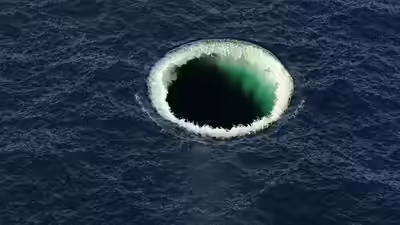
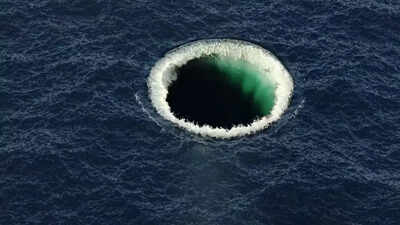
For decades, a vast region south of India has quietly refused to make sense. Satellites mapping Earth’s shape kept returning the same unsettling result: the ocean surface there sits noticeably lower than it should, as if something invisible is pulling it down from below. Ships passing through would never notice anything unusual, yet space-based measurements tell a different story entirely. The area spans an enormous stretch of the Indian Ocean geoid low, and its behaviour has long left scientists circling incomplete answers. Now, a new explanation has emerged from deep-earth modelling that traces forces far beneath the seafloor, though not everyone agrees on how settled the picture really is.
The mysterious “sunken” patch beneath the Indian Ocean
The so-called gravity anomaly in the Indian Ocean was first identified in satellite data decades ago, and it has remained stubbornly difficult to pin down ever since. Instead of a smooth, evenly curved ocean surface, this region appears slightly “sunken”, as if the planet’s shape dips by more than a hundred metres across a massive zone.Early ideas tried to link it to crustal thickness or scattered density differences in the mantle beneath the seabed. None of those explanations really held up when tested against global data. The pattern was too large, too organised, and oddly persistent. Even with improved satellite mapping, the anomaly refused to fade into a neat explanation.
A hidden driver deep beneath Earth’s surface
The study suggests the answer may lie far deeper than the ocean floor, in the slow churn of Earth’s mantle. Instead of a local cause, the distortion appears to be linked to a sprawling zone of unusually hot, light material that stretches hundreds of kilometres underground.This material is thought to be linked to a vast mantle upwelling, reportedly originating from a much larger system beneath Africa. As it moves, it does not rise straight upward. Instead, it spreads and drifts sideways, influenced by the motion of tectonic plates above it. Over time, this drifting heat appears to have created a region of reduced mass beneath the northern Indian Ocean.In simple terms, less dense material below means slightly weaker gravity above. That imbalance produces the Indian Ocean geoid low, giving the impression of a subtle yet enormous dip in the sea surface when measured from space.
How deep-Earth simulations recreated a 100-million-year geological puzzle
To test the idea, scientists built complex computer models that attempted to reconstruct Earth’s interior stretching back more than 100 million years. These simulations tracked how tectonic plates shifted, how heat moved through the mantle, and how ancient subduction zones might still be affecting the planet today.Out of multiple scenarios, only a handful managed to recreate something close to the observed gravity pattern. One model, in particular, showed a convincing match. It suggested that the anomaly did not form quickly but developed gradually as hot mantle material migrated eastwards beneath the Indian Ocean.The motion of the Indian tectonic plate also seems to play a role, effectively helping steer this deep heat flow across vast distances. Over millions of years, that combination may have shaped the unusual gravity signature we measure today.