

Generative AI
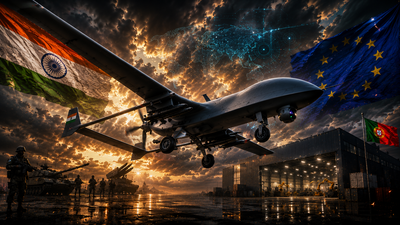
India’s AI combat aircraft Kaal Bhairava will now be manufactured in Portugal after Indian AI warfare company Flying Wedge Defence and Aerospace (FWDA) announced a partnership with European defence-tech firm SKETCHPIXEL, in a development that could mark a turning point for India’s ambitions to become a global defence exporter.On paper, the partnership signals that Indian defence startups are beginning to attract global manufacturing and military integration partners, particularly within Europe’s Nato-linked ecosystem.An Indian-designed autonomous combat aircraft entering the European manufacturing ecosystem is an endeavour Indian defence planners seemingly wanted for years. But beyond the symbolism lies a far bigger story involving military technology, Nato interoperability, artificial intelligence, export controls, defence geopolitics and the rapidly changing nature of modern warfare.
The agreement also highlights something increasingly visible in global defence manufacturing as the military power is no longer built entirely inside geographical limits. Countries now design in one region, manufacture in another, source chips from elsewhere and integrate software through multinational partnerships. In that world, Kaal Bhairava may represent not just a drone project, but a glimpse into how future military-industrial alliances will operate.Under the agreement, India’s FWDA will retain intellectual property rights over Kaal Bhairava’s core autonomous systems and airframe design, while Portugal-based SKETCHPIXEL will contribute manufacturing capabilities, simulation technologies, AI integration, communications systems and interoperability infrastructure.That distinction matters because in modern defence manufacturing, inventing a platform and operationalising it globally are two very different challenges.
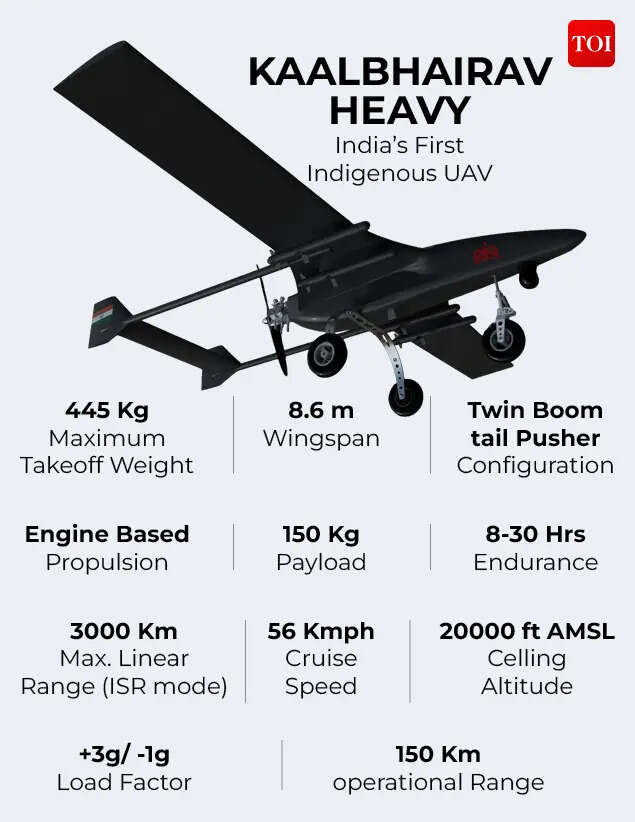
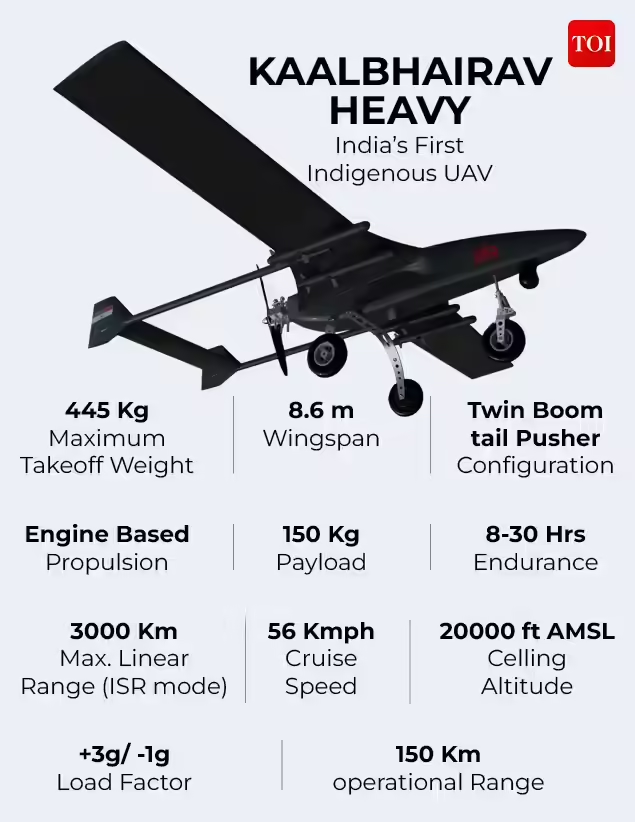
Kaalbhairav heavy
India has spent years trying to position itself as a defence exporter rather than merely one of the world’s largest arms importers. Yet many Indian defence products still struggle with perception barriers in Western markets, where buyers often place greater trust in platforms integrated into European or Nato-standard industrial ecosystems.Manufacturing in Portugal changes that equation.A combat aircraft assembled inside Europe potentially gains easier access to certification pathways, testing ecosystems and interoperability standards expected by Nato-linked militaries. It also gives the platform political credibility among European buyers who may otherwise hesitate to procure systems manufactured entirely outside the Western defence ecosystem. This is where the Portugal angle becomes strategically significant.Portugal itself is not among Europe’s largest military powers, but it sits firmly inside the Nato structure and offers access to European defence-industrial networks. By partnering with a European company familiar with Nato simulation and military integration standards, FWDA is effectively positioning Kaal Bhairava as more than just an Indian drone. It is attempting to position the aircraft as a globally deployable combat platform.
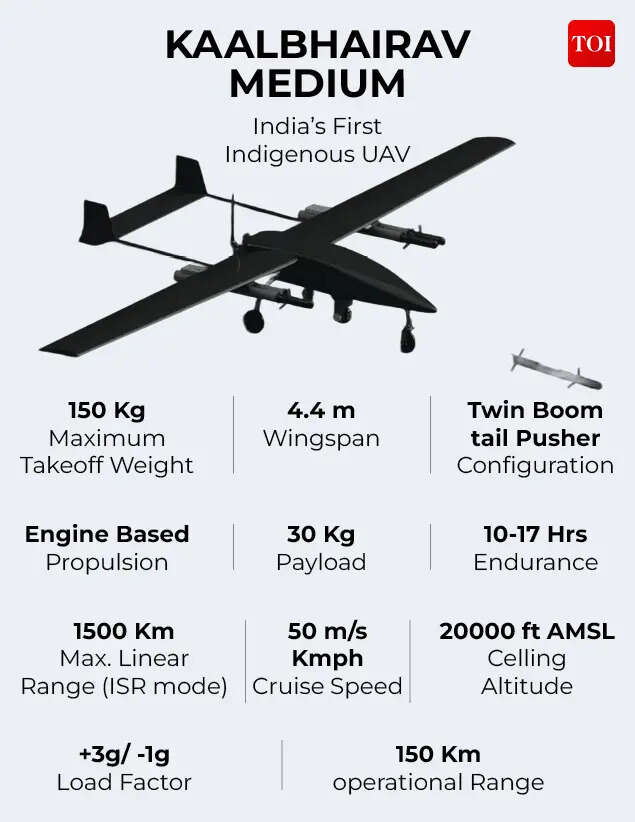
Kaalbhairav medium
The role of SKETCHPIXEL is particularly notable in that context. The company is known for advanced military simulation systems linked to fighter aircraft such as the F-16. According to the companies, the partnership will involve collaboration on AI modules, encrypted communication systems and live-virtual-constructive simulation technologies, commonly referred to as LVC systems.That may sound technical, but it is increasingly central to modern warfare.Today’s militaries do not merely buy aircraft, but focus on having a substantial stake in the ecosystems. A modern combat drone is expected to communicate securely with command centres, air-defence systems, satellites, allied aircraft and battlefield networks in real time. Militaries want platforms capable of operating in coalition environments where different countries’ systems must exchange information seamlessly during missions.This concept, known as interoperability, has become one of the most important requirements in global defence procurement.A drone that cannot integrate with allied military systems becomes significantly less useful during joint operations. That is why Nato compatibility matters so much. If Kaal Bhairava can genuinely operate within Nato-oriented communication and simulation environments, it dramatically expands the platform’s potential export market.The aircraft itself also reflects the broader shift under way in unmanned warfare.Kaal Bhairava is a medium-altitude long-endurance autonomous combat aircraft with a 3,000-km operational range and endurance exceeding 30 hours. In practical terms, the platform appears closer to systems such as the American MQ-9 Reaper, Turkey’s Bayraktar Akinci or China’s Wing Loong series.Unlike loitering munitions, which are essentially disposable strike platforms designed to identify a target and destroy themselves during the attack, Kaal Bhairava appears to belong to an entirely different class as it is designed for persistence rather than one-way missions.
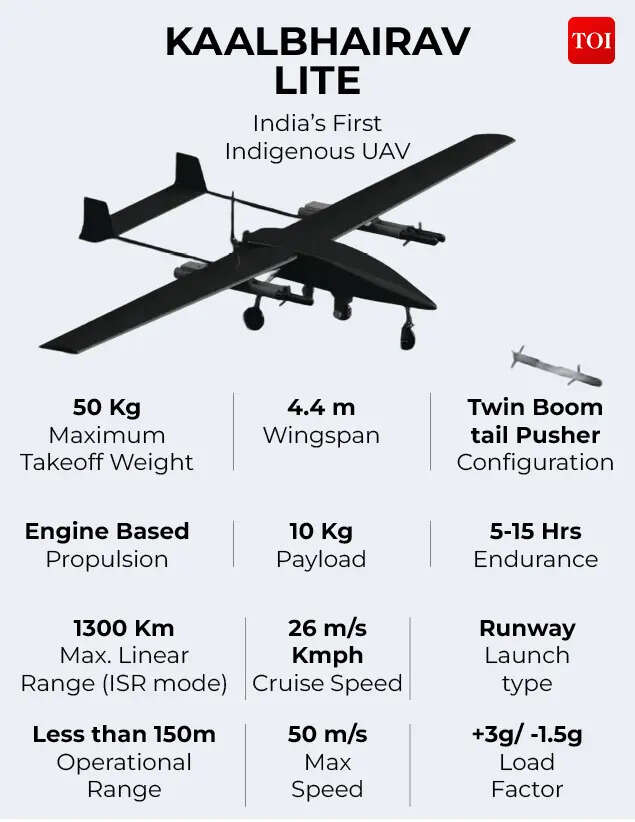
Kaalbhairav lite
A long-endurance combat drone can remain airborne for more than a day, monitor large geographical areas, gather intelligence, coordinate operations and potentially carry out precision strikes without immediate human piloting. That combination of endurance, surveillance and autonomy is what makes Medium Altitude Long Endurance (MALE-class) combat drones strategically valuable. Its reported swarm coordination capability may be even more significant.Modern warfare is increasingly shifting toward “mothership and swarm” concepts in which larger AI-enabled drones coordinate multiple smaller autonomous systems across the battlefield. Instead of relying on a single expensive aircraft, militaries are experimenting with networks of unmanned systems capable of overwhelming enemy defences through coordination and numbers.The United States, China, Turkey and Russia are all investing heavily in such concepts. Conflicts in Ukraine and the Middle East have accelerated that trend dramatically, showing how relatively inexpensive autonomous systems can disrupt traditional military doctrines built around tanks, fighter aircraft and heavily centralised command structures. Artificial intelligence sits at the centre of that transition.FWDA claims Kaal Bhairava incorporates AI-driven target-recognition systems capable of identifying vehicles, infrastructure or hostile activity faster than conventional human-only analysis. Militaries increasingly view such systems as force multipliers because they reduce reaction times and allow operators to monitor vast operational areas more efficiently.But this is also where the conversation becomes politically and ethically complicated.Autonomous combat systems remain vulnerable to errors, electronic warfare attacks, communication disruptions and target misidentification in unpredictable combat environments. AI systems trained under controlled conditions may behave differently in real-world scenarios involving weather disruptions, civilian movement, signal interference or incomplete battlefield information. That concern is no longer hypothetical.The global debate around autonomous weapons has intensified over the past few years as AI-enabled military systems have increasingly appeared in active conflict zones. Critics argue that meaningful human oversight must remain central to any lethal decision-making process involving autonomous systems.At the same time, military planners argue that AI-enabled systems may ultimately reduce human casualties by improving surveillance accuracy and reducing the need to place soldiers in high-risk environments. However, the ethical risk is likely to define future debates around autonomous warfare.For India, however, the Portugal partnership carries strategic importance beyond the technology itself.It signals that Indian defence startups are beginning to move beyond domestic procurement cycles and position themselves inside the global military-industrial ecosystem. For decades, India remained heavily dependent on imports from Russia, France, Israel and the United States for advanced defence platforms. While indigenous defence manufacturing expanded over the years, Indian firms still struggled to achieve significant penetration in Western defence markets.Kaal Bhairava’s European manufacturing partnership suggests Indian defence companies are now attempting a different strategy: design domestically, then integrate globally.That model mirrors trends visible in other high-technology industries. Modern semiconductor manufacturing, for example, already operates through globally distributed supply chains where design, fabrication and integration occur across multiple countries. Defence manufacturing appears to be moving in a similar direction. Yet the arrangement also raises difficult questions within India.If high-value manufacturing increasingly shifts abroad, sections of India’s domestic industrial ecosystem could lose out on skilled jobs, component contracts and long-term maintenance revenue. Questions around technology transfer and export control could become more complicated once production enters European regulatory frameworks.This is one of the central paradoxes of globalised defence production. International partnerships improve market access and technological integration, but they can also dilute national control over exports and supply chains.Still, the broader geopolitical message remains hard to ignore.For years, Indian defence discussions revolved around dependence on foreign platforms. Today, the conversation is slowly shifting toward whether Indian-designed systems can compete globally. The Kaal Bhairava partnership may not instantly transform India into a defence-export superpower, but it reflects a significant evolution in ambition. More importantly, it reflects how warfare itself is changing.The future battlefield will likely be shaped less by standalone tanks or fighter jets and more by interconnected systems powered by software, artificial intelligence, autonomous coordination and real-time data integration. In that environment, countries capable of building AI-enabled military ecosystems may hold a strategic advantage over those relying solely on conventional firepower.Kaal Bhairava is emerging precisely at that intersection of AI, autonomy, geopolitics and military transformation.And in an era increasingly defined by autonomous warfare and AI-driven military systems, that shift may prove far more important than a single drone programme.