
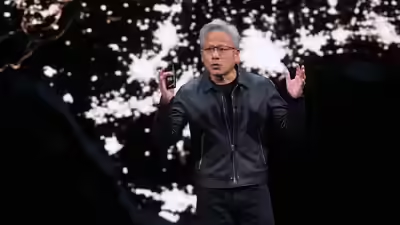
Nvidia CEO Jensen Huang has a simple answer for everyone treating Google‘s TPU push, Meta’s homegrown MTIA chips, Anthropic’s multi-gigawatt compute deal, Amazon’s near-sold-out Trainium4, and OpenAI’s Broadcom silicon project as a five-alarm fire for the world’s most valuable chipmaker: you’re all misreading the situation. One by one, the biggest names in AI are quietly building around Nvidia—and Huang spent a significant stretch of a nearly two-hour podcast making the case that none of it is quite what it looks like.In a wide-ranging conversation on the Dwarkesh Podcast published Tuesday, Huang argued that what looks like customer defection is actually something far more specific. Anthropic’s massive pivot to Google TPUs—a deal with Broadcom locking in roughly 3.5 gigawatts of computing capacity through 2031—isn’t a market signal, he said. It’s one company’s unusual history. “Anthropic is a unique instance, not a trend,” Huang told host Dwarkesh Patel. “Without Anthropic, why would there be any TPU growth at all? It’s 100% Anthropic.”The pushback comes as pressure on Nvidia mounts from multiple directions at once. Meta has unveiled four new in-house MTIA chips co-developed with Broadcom. Amazon’s Trainium4 is reportedly near sold out. OpenAI is co-designing its own silicon with Broadcom. And Nvidia’s stock has lurched on every headline, shedding roughly $250 billion in market value after reports that Meta was even exploring a Google TPU deal.
Jensen Huang’s case for Nvidia’s dominance: Rivals are promising what they haven’t built yet
Huang’s defense of Nvidia’s position centers on a familiar argument—that CUDA’s ecosystem, its hundreds of millions of installed GPUs across every major cloud, and Nvidia’s annual architectural leaps are not things competitors can replicate quickly or cheaply. He pointed to the graveyard of custom chip projects that never delivered. “Look at the number of ASICs that have been canceled,” he said. “Just because you’re going to build an ASIC doesn’t mean you’ve built something better than Nvidia.“On the margins question—the idea that Nvidia’s roughly 70% gross margins create an obvious opening for cheaper alternatives—he was equally direct. “ASIC margins are 65%,” Huang said, arguing the savings customers actually see are far thinner than the narrative suggests.He did concede one genuine miss. Nvidia wasn’t in a position to write the multi-billion dollar early checks that Google and Amazon used to anchor Anthropic in their ecosystems. “I didn’t deeply internalize that they really had no other options,” he said. He’s since invested in both Anthropic and OpenAI, and said he won’t make the same mistake again.
The part Huang didn’t fully answer
What the Dwarkesh interview left unresolved is whether Nvidia’s strengths matter as much in the next phase of AI as they did in the last one. The training era—where Nvidia’s general-purpose GPUs and CUDA programmability were genuinely hard to beat—is giving way to an inference-dominated market. Bank of America estimates inference will account for 75% of AI data center spending by 2030, up from around 50% last year.That’s where the cost math looks different. Google’s Ironwood TPU reportedly delivers total cost of ownership 30–44% lower than Nvidia’s GB200 server for inference workloads. Nvidia has responded by licensing Groq’s inference-focused architecture—a move that signals, more than any press release, that the company knows where the competitive threat is actually coming from.Huang’s long-run bet is that AI will keep demanding the kind of architectural flexibility only Nvidia offers—that researchers building new attention mechanisms, hybrid models, or techniques nobody has invented yet will keep reaching for CUDA first. “The ability to invent new algorithms is really what makes AI advance so quickly,” he said. It’s a compelling argument. Whether it survives contact with an inference market that rewards efficiency over flexibility is what the next few years will decide.