
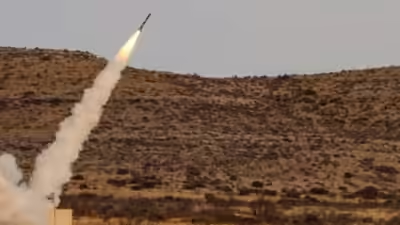
The conflict in Ukraine and West Asia have demonstrated the need for low cost long range weapons that can be deployed against an adversary at scale. The US too is working to procure such systems. The United States’ aerial assault on Iran has consisted of Tomahawk and Joint Air-to-Surface Standoff Missile (JASSM) weapons. The replacement of the weapons fired are expected to cost $2.6 million each according to Washington DC based policy research organisation Center for Strategic and International Studies (CSIS).The US Department of War announced a framework agreement with Anduril Industries to rapidly scale production of a new, affordable and mass-producible cruise missile solution to the long-range precision fires and stand-off strike problem called the surface-launched Barracuda-500M (SLB-500M), as stated by the Department of War.The agreement covers the procurement and delivery of a minimum of 3,000 SLB-500M systems over three years as part of the ground-launched low-cost containerised munition program. As per the agreement, the firm will scale production to deliver a minimum of 1,000 all-up rounds per year, with the first tranche of deliveries taking place in the first half of 2027, just one year after contract award along with at least 60 launchers.The weapon is an affordable munition that enables high-volume, coordinated, long range strikes. Equipped with a 100 pound munition payload and offering a range of around a thousand kilometers, the weapon has a stand-off strike capability that is designed to be effective against a wide range of land and maritime targets in contested environments against a peer or near-peer adversary, which is believed to be China.The ongoing conflict in Ukraine has demonstrated the need for a robust industrial base that can churn out weapons at scale to sustain the needs of the armed forces during a conflict in a cost effective manner. The Indian Armed Forces too are working to acquire a similar capability of low-cost mass effects. These systems will be acquired under the Low Cost Capital Acquisition (LCCA), which will be a part of the new and upcoming Defence Acquisition Procedure (DAP) 2026, according to a source in the armed forces. The services are planning to acquire drones, rockets and missile based systems. The army’s Corps of Electronics and Mechanical Engineers (EME) is also acquiring capabilities to make and sustain a large number of drones.The conflict in Ukraine and West Asia have demonstrated the need for low cost long range weapons that can be deployed against an adversary at scale. The US too is working to procure such systems. The United States’ aerial assault on Iran has consisted of Tomahawk and Joint Air-to-Surface Standoff Missile (JASSM) weapons. The replacement of the weapons fired are expected to cost $2.6 million each according to Washington DC based policy research organisation Center for Strategic and International Studies (CSIS).The US Department of War announced a framework agreement with Anduril Industries to rapidly scale production of a new, affordable and mass-producible cruise missile solution to the long-range precision fires and stand-off strike problem called the surface-launched Barracuda-500M (SLB-500M), as stated by the Department of War.The agreement covers the procurement and delivery of a minimum of 3,000 SLB-500M systems over three years as part of the ground-launched low-cost containerised munition program. As per the agreement, the firm will scale production to deliver a minimum of 1,000 all-up rounds per year, with the first tranche of deliveries taking place in the first half of 2027, just one year after contract award along with at least 60 launchers.The weapon is an affordable munition that enables high-volume, coordinated, long range strikes. Equipped with a 100 pound munition payload and offering a range of around a thousand kilometers, the weapon has a stand-off strike capability that is designed to be effective against a wide range of land and maritime targets in contested environments against a peer or near-peer adversary, which is believed to be China.The ongoing conflict in Ukraine has demonstrated the need for a robust industrial base that can churn out weapons at scale to sustain the needs of the armed forces during a conflict in a cost effective manner. The Indian Armed Forces too are working to acquire a similar capability of low-cost mass effects. These systems will be acquired under the Low Cost Capital Acquisition (LCCA), which will be a part of the new and upcoming Defence Acquisition Procedure (DAP) 2026, according to a source in the armed forces. The services are planning to acquire drones, rockets and missile based systems. The army’s Corps of Electronics and Mechanical Engineers (EME) is also acquiring capabilities to make and sustain a large number of drones.