


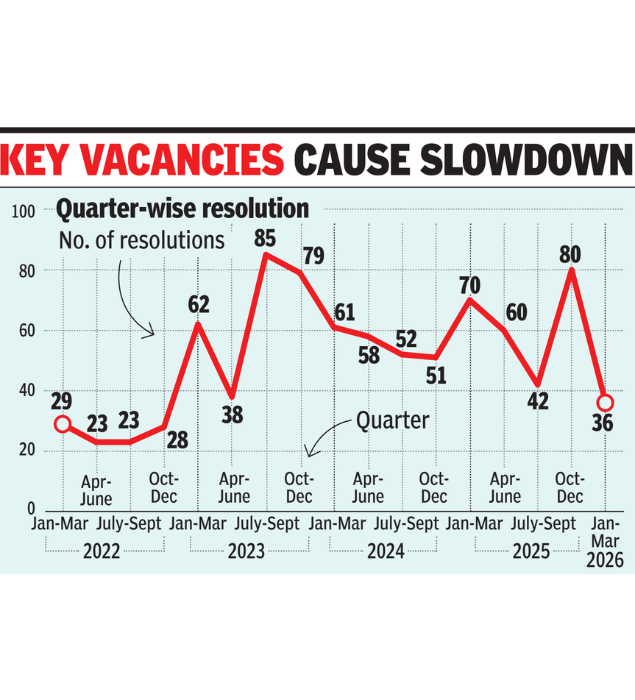
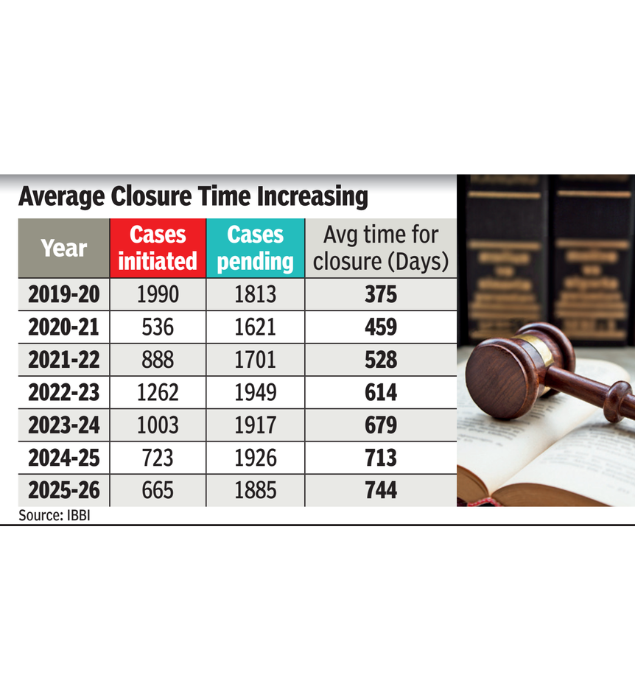
NEW DELHI: Corporate insolvency resolutions dropped to a 13-quarter low of 36 cases being resolved by the National Company Law Tribunal (NCLT) during Jan-March 2026, compared with 70 a year ago, with just eight plans approved in Feb and seven in March. This was the worst March quarter for the resolution process since Jan-March 2022 when just 29 cases were approved, according to Insolvency & Bankruptcy Board of India (IBBI) data. Those tracking the cases said the absence of a full-time NCLT president since the end of Jan was the main reason for slowdown, although there are several vacancies as well. Officials are hopeful that resolution process will now pick up in the NCLT benches, following the appointment of new president Justice Anupinder Singh Grewal in May. As a result, the average time taken for closure of corporate insolvency cases has shot up to 744 days, compared with 713 a year ago. The current time being taken is nearly three times the extended framework of 270 days provided under the Insolvency & Bankruptcy Code (IBC), which was enacted in 2016 to help fast-track the process, but is now hit by massive delays.

.
Last month, the Supreme Court also flagged its concern over delays in approval of resolution plans. Officials said amendments to IBC will also speed up the process.
.
“The process has been criticised for delays in admission of a corporate debtor (company) into CIRP (corporate insolvency resolution process). The amendments now provide that in applications made by financial institutions, a record of default issued by the IU (information utility), would be counted as sufficient proof of default. This addresses a key bottleneck where admission of cases was often delayed due to prolonged litigation on evidence of default. By recognising IU records as reliable and structured evidence, the process becomes faster and more objective,” IBBI chairman Ravi Mittal said in the monthly newsletter. The ministry of corporate affairs and IBBI have also proposed having more benches of NCLT, a proposal which has also received the backing of the Parliamentary committee dealing with amendments to IBC, but is pending with govt. For creditors, IBC remains the preferred mode to deal with pending dues.