









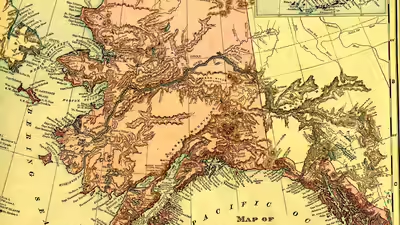
In 1867, Russia’s decision to sell Alaska to America turned out to be a historic mistake that was to go unnoticed for years to come. The sum paid by the US was only $7,200,000. Although, in the light of the circumstances at the time, it appeared logical, retrospectively, the act looks extremely shortsighted. Russia found itself economically constrained, geographically far away from the region and fearful of its falling into the hands of the British without any compensation. In reality, however, the region had proved immensely valuable both strategically and naturally.
Why Russia agreed to the Alaska purchase
The choice of selling Alaska was based on economic and political reasons. By the middle of the 19th century, the Russian Empire experienced financial difficulties as a result of the expensive Crimean War. It had become increasingly hard for the country to manage such remote and thinly populated areas as Alaska.According to EBSCO, “the Russian-American Company was in decline, and the colony failed to yield any profit”. In addition to this, the lucrative fur trade had declined, making the territory much less economically valuable for the empire.At the same time, Russia was afraid that Britain might capture Alaska in case another war broke out between the two countries. Selling the colony to the friendly United States appeared as a logical step. As the Office of the Historian states, William H. Seward, U.S. Secretary of State, “it was a chance to expand its influence in North America and hinder further growth of Britain”.For Russia, the transaction was a chance to minimise the losses. However, it greatly undervalued the potential of Alaska.
The hidden wealth Russia gave away
Another thing that Russia did not expect was the amount of riches that Alaska possessed. Within several decades after the acquisition, the state saw discoveries of enormous deposits of gold, oil, and other minerals.“Alaska has produced more than 40 million ounces of gold,” according to the US Geological Survey. Furthermore, Alaska is home to some of the world’s most significant undeveloped mineral deposits, according to the U.S. Geological Survey (USGS). But even more importantly, the state’s oil deposits turned out to be extremely valuable. The Prudhoe Bay oil field was discovered in 1968 and became one of North America’s biggest.In retrospect, the amount paid by the Americans, $7.2 million, or two cents per acre, was rather laughable. According to Howard I. Kushner, the deal “robbed Russia of an enormously rich territory, the true value of which would only be recognised in the twentieth century.”
Strategic and geopolitical consequences
In addition to resources, there is the question of strategy and how important Alaska is to the United States from a strategic standpoint. This is a very good place when it comes to defence strategy. It borders on the Arctic Ocean and also happens to be close to Russia.During the period of the Cold War, the Alaskan region became a frontier area for the United States, becoming home to military facilities and warning systems.According to Col. Michael J. Forsyth, U.S. Army, the closeness of Russia and Alaska, only about ninety kilometres apart across the Bering Strait, meant that this region became highly significant to the United States’ defence plans.From today’s point of view, the strategic location of Alaska makes the state very important to the policies of the U.S. related to the Arctic, energy security, and even environmental policies.Thinking back, what seems clear to us now is that the Russians sold Alaska due to immediate needs rather than future considerations. In order to solve the problem, they lost a valuable resource for Russia.Conclusively, the Alaska Purchase should not have been done as it has had a significant impact that will remain throughout history.