
A year before the fierce exchange of US-Israeli and Iranian missiles in West Asia, the Indian subcontinent briefly witnessed a similar scale of aerial drama during Operation Sindoor. India hit Pakistani airbases and radar sites and successfully intercepted projectiles fired by Pakistan. India demonstrated its dominance by compelling a nuclear-armed rival to sue for peace within 88 hours.In the only missile exchange between two nuclear-armed neighbours, Pakistan blinked first. The subcontinent remains one of the most sensitive nuclear regions, with India and Pakistan maintaining near parity in their nuclear arsenals. Pakistan is estimated to possess around 170 warheads, while India holds approximately 172, underscoring a fragile balance of deterrence between the two rivals.Pakistan’s nuclear capability rests on a triad of land, air and budding sea platforms. Its land‑based missiles include short‑range systems such as Abdali and Ghaznavi, medium‑range Shaheen‑I and Shaheen‑II, and longer‑range Shaheen‑III and Ghauri. Tactical systems like Nasr provide battlefield nuclear options, while Ababeel introduces multiple independently targetable reentry vehicles, according to Pakistani reports.

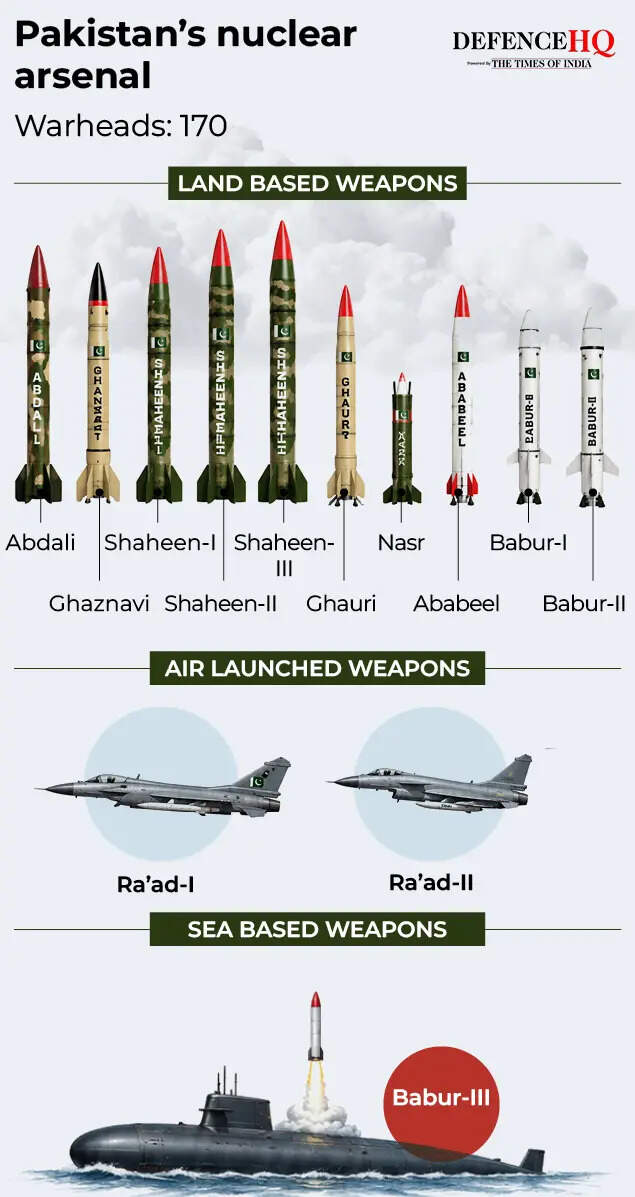
Cruise missiles Babur‑I and Babur‑II add precision strike capability. In the air domain, Pakistan fields the Ra’ad‑I and Ra’ad‑II air‑launched cruise missiles, designed for deployment from fighter aircraft. At sea, the Babur‑III submarine‑launched cruise missile extends deterrence into the maritime sphere, though Pakistan’s sea leg remains relatively limited.India’s arsenal reflects its doctrine of credible minimum deterrence and a declared No First Use policy. Its land‑based missiles range from the short‑range Prithvi‑II and Agni‑I to the intercontinental Agni‑V and the developmental Agni‑VI. The Agni‑P represents a newer precision‑strike variant. In the air leg, India relies on nuclear‑capable aircraft such as the Mirage‑2000, Jaguar, and Rafale, offering flexible targeting options. The sea leg is India’s most strategically significant, anchored by submarine‑launched ballistic missiles K‑15, K‑4, and the under‑development K‑5. These systems, deployed aboard nuclear‑powered ballistic missile submarines like INS Arihant, ensure survivability and second‑strike capability.

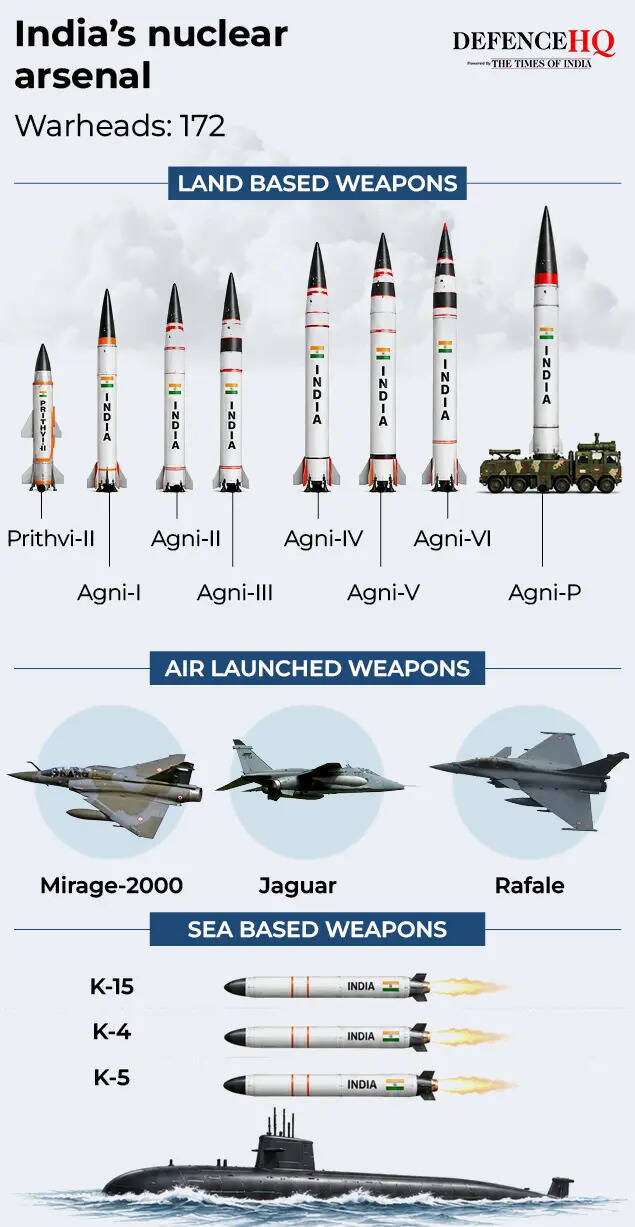
Both countries’ arsenals reflect divergent philosophies. Pakistan emphasises tactical nuclear weapons to offset conventional asymmetry with India, while India prioritizes survivable long‑range deterrence. Yet both nations recognise the stabilising effect of a triad, ensuring that neither side can risk a disarming first strike without inviting devastating retaliation.A year before the fierce exchange of US-Israeli and Iranian missiles in West Asia, the Indian subcontinent briefly witnessed a similar scale of aerial drama during Operation Sindoor. India hit Pakistani airbases and radar sites and successfully intercepted projectiles fired by Pakistan. India demonstrated its dominance by compelling a nuclear-armed rival to sue for peace within 88 hours.In the only missile exchange between two nuclear-armed neighbours, Pakistan blinked first. The subcontinent remains one of the most sensitive nuclear regions, with India and Pakistan maintaining near parity in their nuclear arsenals. Pakistan is estimated to possess around 170 warheads, while India holds approximately 172, underscoring a fragile balance of deterrence between the two rivals.Pakistan’s nuclear capability rests on a triad of land, air and budding sea platforms. Its land‑based missiles include short‑range systems such as Abdali and Ghaznavi, medium‑range Shaheen‑I and Shaheen‑II, and longer‑range Shaheen‑III and Ghauri. Tactical systems like Nasr provide battlefield nuclear options, while Ababeel introduces multiple independently targetable reentry vehicles, according to Pakistani reports.Cruise missiles Babur‑I and Babur‑II add precision strike capability. In the air domain, Pakistan fields the Ra’ad‑I and Ra’ad‑II air‑launched cruise missiles, designed for deployment from fighter aircraft. At sea, the Babur‑III submarine‑launched cruise missile extends deterrence into the maritime sphere, though Pakistan’s sea leg remains relatively limited.India’s arsenal reflects its doctrine of credible minimum deterrence and a declared No First Use policy. Its land‑based missiles range from the short‑range Prithvi‑II and Agni‑I to the intercontinental Agni‑V and the developmental Agni‑VI. The Agni‑P represents a newer precision‑strike variant. In the air leg, India relies on nuclear‑capable aircraft such as the Mirage‑2000, Jaguar, and Rafale, offering flexible targeting options. The sea leg is India’s most strategically significant, anchored by submarine‑launched ballistic missiles K‑15, K‑4, and the under‑development K‑5. These systems, deployed aboard nuclear‑powered ballistic missile submarines like INS Arihant, ensure survivability and second‑strike capability.Both countries’ arsenals reflect divergent philosophies. Pakistan emphasises tactical nuclear weapons to offset conventional asymmetry with India, while India prioritizes survivable long‑range deterrence. Yet both nations recognise the stabilising effect of a triad, ensuring that neither side can risk a disarming first strike without inviting devastating retaliation.