
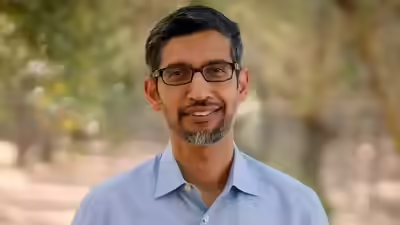
Sundar Pichai was appointed CEO of Google in October 2015, and later took charge of its parent company, Alphabet, in December 2019. Known for his calm and understated leadership style, Pichai is one of those rare executives who lets results speak louder than words. What many people do not know is that Google Chrome, which is now the world’s most widely used browser by market share, was his brainchild. His quiet, methodical approach to building things has defined his career, including his approach of announcing Google as an AI-first company back in 2016. In a recent conversation, he shared the moment he felt it most clearly.According to an interview in Time Magazine, years ago, during a family vacation in Hawaii, Pichai found himself battling rough, pummeling waves while attempting to scuba dive. As the water crashed against him, he seriously considered turning back to safety. But he kicked downward, and just a few feet below the surface, the chaos of the storm vanished. Pichai describes finding “the calmest place in the world,” where he was overcome by a meditative stillness.“I feel that in any situation, there is a layer which is super calm—in which, if you can get there, you can observe what’s going on. And your mind’s energy is focused on what you need to do,” Pichai explained during a recent interview at Google’s headquarters.This story serves as a perfect metaphor for Pichai’s tenure as CEO of Google and Alphabet. While he oversees the world’s second most valuable company, he remains remarkably low-key. Compared to the his peers like Elon Musk or Mark Zuckerberg, who are regularly in the news, Pichai is practically anonymous. According to Time, his style has often led critics to mistake his calmness for corporate inertia.
Weathering the AI storm in 2022
In late 2022, Pichai’s “calm” was put to the ultimate test with the viral success of OpenAI’s ChatGPT. Critics and analysts slammed Google for being “second”, saying the tech giant had lost its edge. Some even compared Google to fallen tech stars like Yahoo!, suggesting the company was afraid to evolve.While many called for his resignation, Pichai remained beneath the surface. In a recent podcast, he hinted that while the world was criticising the company, Google was busy in meeting the quality bar.The internal version, he said in a conversation on Stripe co-founder John Collison’s podcast Cheeky Pint,, wasn’t sufficiently refined through RLHF alignment. The version he personally reviewed was “a lot more toxic at a level. We couldn’t have possibly put it out at that time!”He also pointed to Google’s 2022 I/O conference, where the company launched AI Test Kitchen-a constrained, public-facing version of LaMDA that let a limited number of users interact with the model. It landed with little fanfare. Months later, ChatGPT went viral, crossing a million users within days of its late November launch.“As a company which had this search quality bias, we had a higher bar, maybe, for what we thought was an acceptable product quality to go out. But it wasn’t like… we were figuring out how to get it out,” Pichai said.It turns out Pichai appears to be preparing for this exact shift for ten years. The company has quietly cultivated a massive ecosystem of projects, including custom chips, YouTube, Cloud, and deep AI research, that appeared disconnected at the time but are now central to Google’s future.