
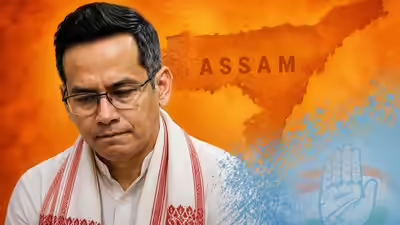
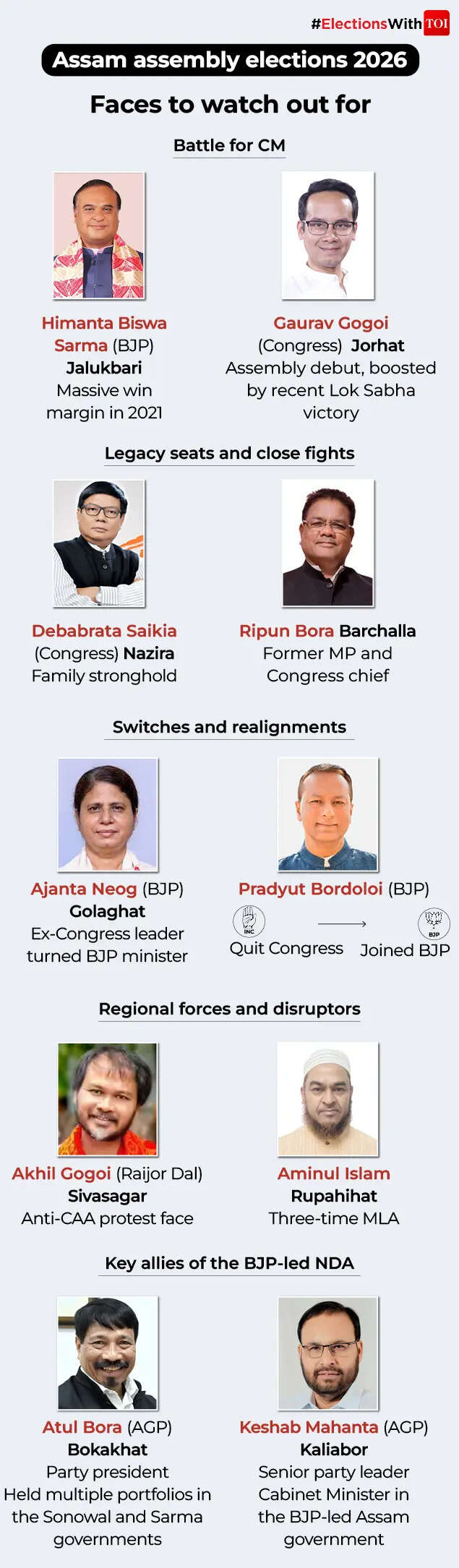
Assam once cheered Gaurav Gogoi as “amar lora” (our son) when he stepped into Jorhat during the 2024 Lok Sabha elections, embracing him as a son of the soil. Gogoi was not only the deputy leader of the opposition in the Lok Sabha but also the party’s chief ministerial face and the living legacy of late chief minister Tarun Gogoi. However, in the 2026 assembly elections that emotional connection did not translate into votes.Gogoi was seen as Congress‘ last nail in the coffin of BJP in Assam, but the grand old party lost yet again, underlining its steadily shrinking footprint in the state.
Gogoi’s defeat is not just a personal setback but also reflects a deeper churn in Assam’s politics, where legacy, identity, and strategy collided and the Congress fell short.
Why Gogoi’s defeat matters
Gogoi was not just another candidate in this election. He was the Congress’ chief ministerial face, its most visible campaigner, and arguably its best hope to challenge the dominance of Himanta Biswa Sarma.As a three-term MP and former deputy leader of the opposition in the Lok Sabha, Gogoi carried both experience and expectation. Yet, the verdict turned out to be different. Gogoi did not just lose. He lost by a whopping margin of 23,182 to BJP’s Hitendra Nath Goswami.His defeat also ended his attempt to transition from national to state politics, a move that was seen as crucial for Congress’ revival in Assam.After the loss, Gaurav Gogoi said that he takes “full moral responsibility”. “As the state Congress president, I take full moral responsibility. I also thank our political workers (who) gave their full potential,” ANI quoted the Assam Congress chief saying.“We accept the people’s mandate. We express our gratitude to those who voted for us and support us. Congress will reach out to those who did not vote for us. We express our gratitude to the grassroot Congress workers who stand with us despite facing problems. We have seen a new Congress,” he said.At the same time, he also hinted at unease within the party over the outcome.“People have not accepted this result. We thought that the fight would be neck to neck. But the result in many seats is thinkable. On Saturday (May 9), we will call every newly elected MLA (of the party),” he added.

The party’s fortress crumbled
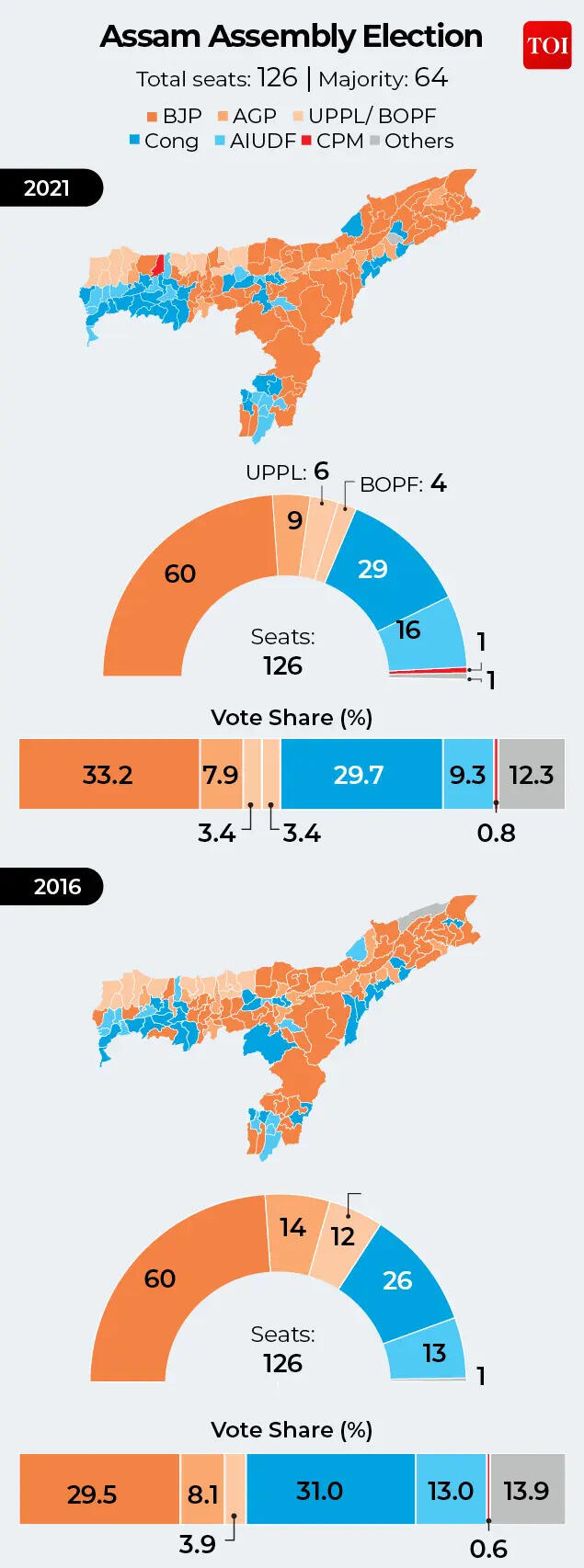
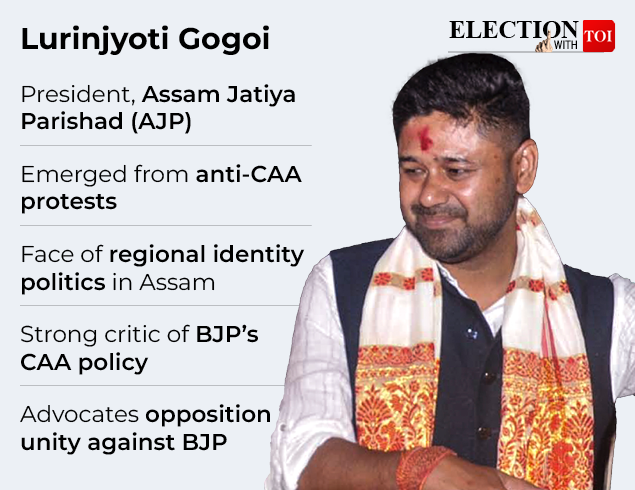
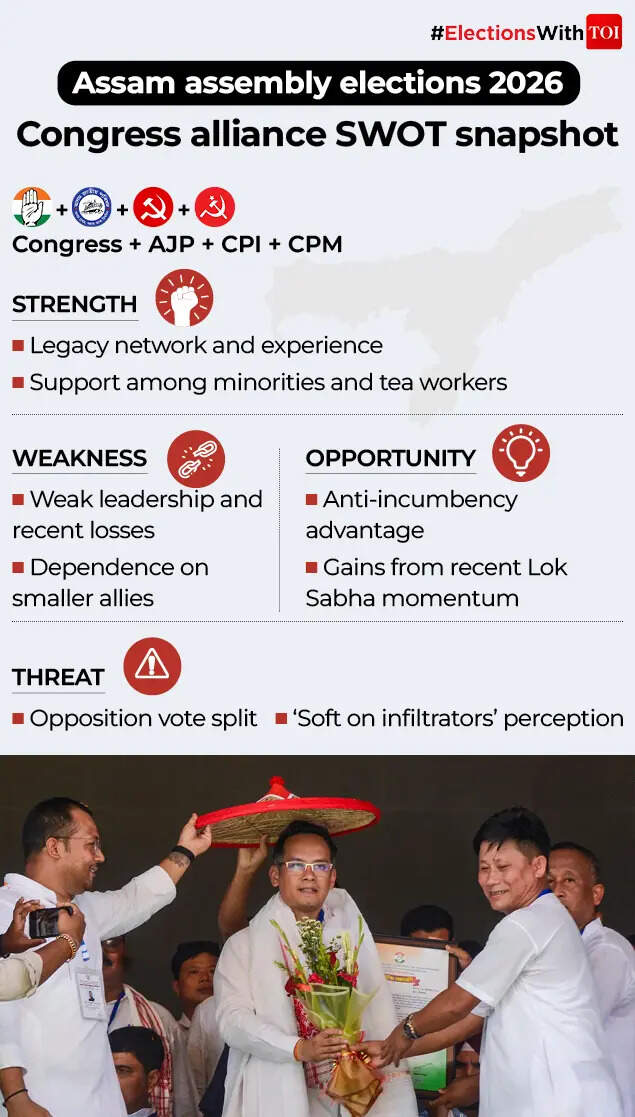
If Gogoi’s loss was symbolic, the defeat of Debabrata Saikia in Nazira was equally significant. Saikia, who had been leader of the opposition since 2016, lost his family stronghold to BJP’s Mayur Borgohain.The twin defeats of Gogoi and Saikia, both sons of former chief ministers signalled a deeper erosion of Congress’ traditional base. For decades, Upper Assam had been the party’s fortress. But in 2026, that bastion crumbled.Congress lost almost all Assembly segments under Gogoi’s Lok Sabha constituency, barring Sivasagar, where ally Akhil Gogoi held ground. Another ally, Lurinjyoti Gogoi, lost in Khowang.What remained was a much narrower political footprint. The Congress managed to win just 19 seats, down from 29 in 2021 and most of these victories came from Muslim-majority constituencies. Its once broad-based coalition of support has now shrunk into a more limited, regionally concentrated vote bank.

The scale of BJP’s dominance
While Congress struggled, the BJP-led NDA surged ahead with remarkable clarity. In the 126-member Assembly, the NDA secured a massive 102 seats, with the BJP alone winning 82, crossing the majority mark on its own for the first time in Assam.For Himanta, this victory reaffirmed his political dominance. Contesting from Jalukbari, he retained his seat by a staggering margin of 89,434 votes.Sarma’s rise has been one of the most consequential political shifts in Assam. After leaving Congress in 2015, he played a key role in expanding the BJP’s footprint across the Northeast. His leadership style, combining welfare delivery with sharp political messaging has reshaped the state’s electoral dynamics.

Why Gogoi’s strategy fell short
The BJP framed Gogoi, Akhil Gogoi and Lurinjyoti Gogoi as the “3G” trio, in what was widely seen as a politically loaded label.The campaign also sought to portray the Congress as a party aligned with “Miya” Muslims, a term used for Bengali-speaking Muslims of migrant origin. This messaging, repeated consistently, appears to have influenced voter perception.It made it harder for Congress to expand beyond Muslim-majority constituencies and regain support among indigenous Assamese communities, including the Ahom community to which the Gogoi family belongs.Several factors contributed to Gogoi’s defeat, some structural, others personal.One key challenge was the Congress party’s inability to reconnect with its traditional support bases. The Ahom community, tea garden tribes, and sections of Hindu voters, once central to Congress’ strength have gradually shifted away over the years.Another issue was Gogoi’s perceived inaccessibility. Many party workers and voters felt he was not visible enough on the ground during the campaign. In a state where grassroots engagement matters deeply, this perception hurt.His reliance on legacy and identity politics particularly his Ahom roots, also did not yield the expected results.
The impact of delimitation?
The 2023 delimitation exercise also played a crucial role in reshaping Assam’s political landscape.The number of Muslim-majority constituencies dropped from 35 to 22, significantly narrowing Congress’s electoral space. While Muslims account for around 30% of Assam’s electorate, roughly 75 lakh voters and their concentration in fewer seats has politically isolated the party.
Alliance strategy under scanner
Congress’ alliance strategy also came under scrutiny. While the party stitched together a six-party alliance at the last minute, including Left and regional players, it failed to create a unified, compelling alternative.In earlier elections, divisions within the opposition had already helped the BJP. In 2021, for instance, the opposition’s vote share was close to the NDA’s, but fragmentation led to a significant seat gap.The election outcome has triggered renewed scrutiny of the opposition alliance’s strategy, leadership choices and social outreach.While regional allies attempted to field younger and high-profile candidates, including Gen Z faces such as Kunki Chowdhury and Gyanashree Bora, the experiment failed to translate into electoral gains.Repeated electoral setbacks could deepen organisational fatigue within Congress and its allies. Senior journalist Amarendra Deka noted that defeats of this scale often trigger internal blame games, leadership challenges and cadre demoralisation, problems Congress has grappled with in Assam for years.Even in 2026, despite attempts at coordination, the alliance lacked coherence and mass appeal.

Personal attacks
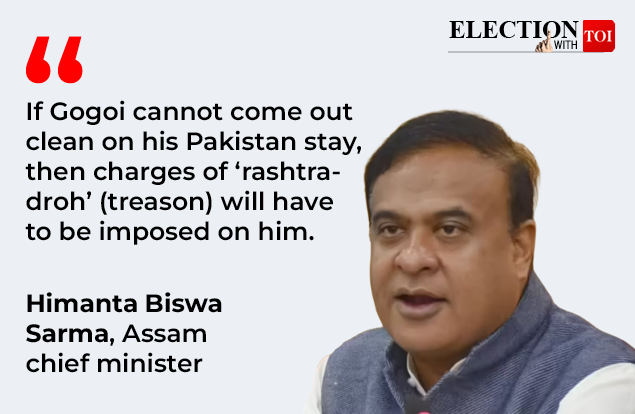
The campaign also saw personal allegations being raised. Sarma repeatedly targeted Gaurav Gogoi over his wife, Elizabeth Colebourn, who is UK-born.He alleged that a Pakistan-based firm had employed her and later transferred her to India, with her salary allegedly paid by a Pakistani national. Sarma also accused Gogoi of visiting Pakistan clandestinely in 2013 without informing authorities, claiming he may have undergone “some kind of training there.”Further, he alleged that Gogoi’s wife collected information about India while working at a firm and passed it on to Pakistan, claiming she had visited Pakistan nine times while associated with two Indian organisations.
The scale of Congress’s defeat
The scale of the BJP-led NDA’s victory in Assam has pushed the opposition into one of its weakest positions in recent memory, raising serious questions about its future political relevance in the state. IIn the 126-member assembly, the NDA stormed to a record 102 seats, with the BJP alone winning 82, enough to secure a majority on its own for the first time in Assam.In contrast, the Congress-led opposition alliance suffered a sharp setback. Congress managed to win only 19 seats, down from 29 in 2021, while ally Raijor Dal secured just two. The AIUDF and Trinamool Congress, which contested separately, won two and one seats respectively.Political observers believe the opposition failed to produce a leadership figure capable of matching chief minister Himanta Biswa Sarma’s political dominance.Despite the visibility of leaders like Gogoi, Raijor Dal’s Akhil Gogoi and AJP chief Lurinjyoti Gogoi, the alliance lacked a unified mass appeal strong enough to counter the BJP’s aggressive and disciplined campaign machinery.

Gogoi’s political beginning
Gaurav Gogoi began his political career in 2014 with a victory from Kaliabor, defeating BJP’s Mrinal Kumar Saikia by 93,000 votes. He strengthened his position in 2019, winning re-election against Moni Madhab Mahanta of the Asom Gana Parishad by a margin of 2,09,994 votes.In 2024, he shifted to Jorhat and defeated BJP’s Topon Kumar Gogoi, receiving a warm public response, with supporters calling him “Amar Lora” (our son), a reflection of his growing connection with the people.Gogoi served as deputy leader of the Congress Parliamentary Party from 2020 to 2024 and was later appointed president of the Assam Pradesh Congress Committee in 2025.With Congress now losing three consecutive assembly elections since 2016, and its seat tally shrinking each time, the party faces a difficult rebuilding exercise in Assam. The opposition requires an urgent rethinking of its political messaging, rebuild grassroots structures and forge a broader social coalition if it hopes to remain electorally relevant by 2031.Failing that, Assam could witness an even stronger consolidation of BJP dominance, with the opposition reduced to a fragmented force struggling for political space.