
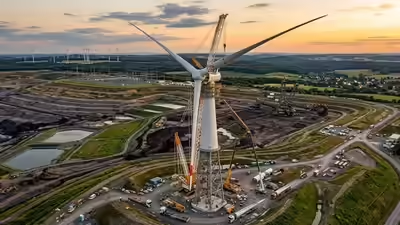
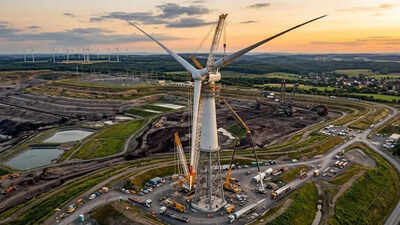
Germany is undergoing a historic industrial transformation, symbolised by the construction of a 364-meter-high wind turbine- the world’s tallest. This is an engineering feat built in a historically mined area, which marks both a monumental shift away from fossil fuels towards creating clean, renewable energy. By building at a minimum height of 364 meters, they will be at a higher elevation where winds are stronger and much more consistent, therefore able to create more electricity as well as better stabilise the clean electricity network. It is not only going to be the highest wind turbine record, but this project will provide actual scientific evidence that decommissioned carbon-intensive assets are capable of being reclaimed and turned into global leaders in sustainable innovation.
Germany sets a new record with the world’s tallest wind turbine at 364 meters high
Constructing a 364-meter-high structure requires specialised engineering to resist atmospheric turbulence and structural loading. According to technical evaluation reports prepared on behalf of the Federal Ministry for Economic Affairs and Climate Action, increasing the height of turbine rotors allows the turbines to reach ‘low-level jets’ – fast-flowing winds that are often more stable than low-level winds. Because of this increase in turbine hub height, turbines will have a much greater capacity factor than if they were installed at or around the ground level. This means that even when there are very low winds at the surface of the earth, these turbines will still generate electricity almost continuously.
Why former coal mines are the perfect wind hubs
Selecting an area in a previously historic coal mining area would provide efficient integration into the grid. The International Renewable Energy Agency (IRENA) indicates that reusing ‘brownfield’ sites (former industrial sites) provides the highest efficiency for energy generation since they usually contain the electrical transmission lines and transformer station infrastructure required to supply large quantities of electricity into the national grid. Therefore, using previously destroyed mining communities for site location minimises the environmental impact of any new transmission lines, while providing an opportunity for redeveloping the economy of traditional mining communities.
The physics of carbon-fibre blades
To ensure safe operation at extreme altitudes, the turbine will employ advanced material science. National Renewable Energy Laboratory (NREL) studies have shown that as turbines get larger, blade weight becomes an inhibiting factor to turbine operation. To overcome this problem, a carbon-fibre-reinforced polymer composite will be used in constructing the 364-meter-high turbine blades, giving them a much better strength/weight ratio than traditional fibreglass blades. This will result in the turbine blades capturing more kinetic energy without introducing excessive loads on the main bearing or nacelle.
How one vertical giant replaces a wind farm
The overall success of the project serves as a blueprint for the European Environment Agency’s (EEA) goal of achieving climate neutrality. Germany will demonstrate how one ultra-tall turbine can replace several smaller units, thus providing an avenue for reducing ‘land-use intensity.’ Further scientific modelling has indicated that these tall turbines could generate as much as two times the energy of their conventional counterparts; therefore, they will be critical to meeting energy production needs for downstream industries while avoiding excessive expansion of land use.