
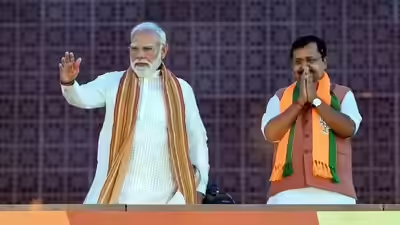
NEW DELHI: After Congress lost seven states in 1967, a popular saying went that one could travel by train from Delhi to Howrah without passing through a single Congress-ruled state.Nearly six decades later, Bharatiya Janata Party has turned the saying on its head with another saying that a journey from Chandigarh in Haryana to Howrah would now pass only through BJP-ruled states.After an overwhelming victory in West Bengal on May 4, Suvendu Adhikari took oath as chief minister, giving the BJP its first government in the state and marking the ninth state where the party has installed a first-time BJP chief minister since Narendra Modi became Prime Minister in 2014.BJP’s expansion began with victories in the Haryana and Maharashtra assembly elections in 2014, followed by Assam and Arunachal Pradesh in 2016, Manipur in 2017, Tripura in 2018, Odisha in 2024, Bihar in 2026 and now West Bengal.

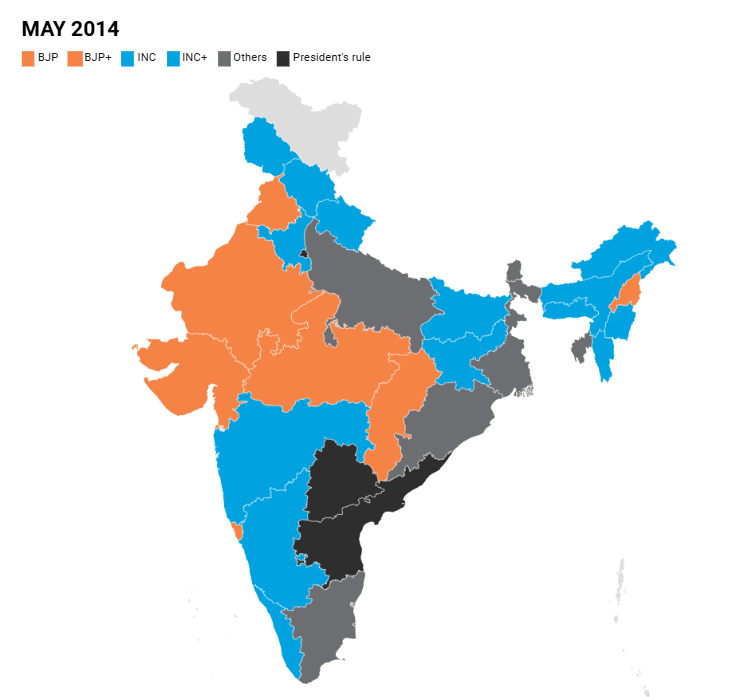
In Haryana, BJP formed a government on its own for the first time and appointed Manohar Lal Khattar as chief minister.In Maharashtra, Devendra Fadnavis became state’s first BJP chief minister after the party emerged as the single-largest party in the assembly elections and formed the government with allies in the Mahayuti alliance.BJP expanded its footprint in the Northeast in 2016 by winning Assam, where Sarbananda Sonowal became the party’s first chief minister in the state.Since then, BJP has retained power in Assam, winning two consecutive assembly elections afterward, including the one held in April.The same year, BJP formed its first full-fledged government in Arunachal Pradesh following a major political realignment.In July 2016, Congress leader Pema Khandu became chief minister amid a prolonged political crisis. Two months later, he and a majority of Congress MLAs joined People’s Party of Arunachal, an ally of BJP.In December that year, Khandu and 33 MLAs switched to BJP, giving the party a clear majority and its first stable government in the state.BJP had earlier briefly headed a government in Arunachal Pradesh in 2003 under former chief minister Gegong Apang. Apang had quit Congress and joined BJP, but his government lasted only 44 days before he returned to the Congress.

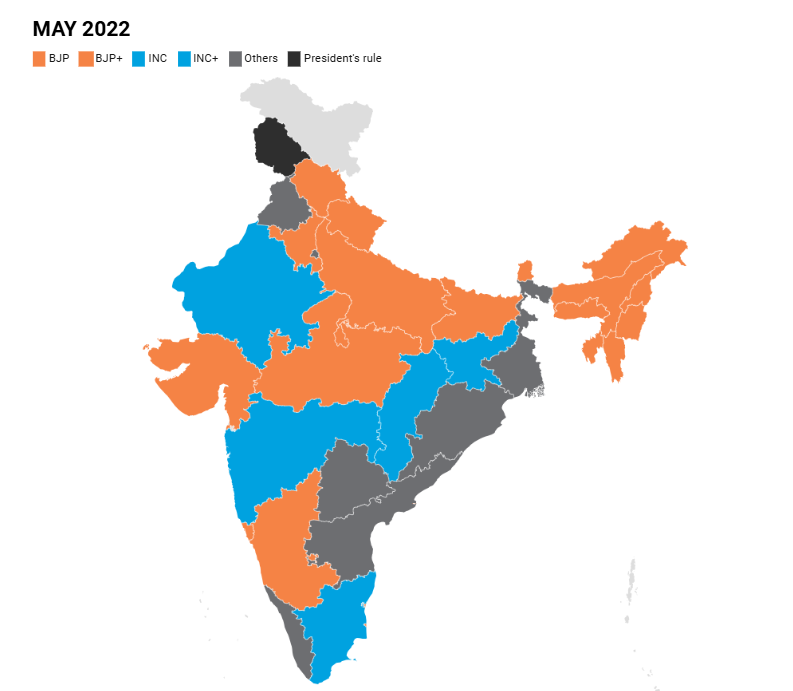
In 2017, BJP stitched together a post-poll alliance with National People’s Party, Naga People’s Front and regional parties in Manipur to install N Biren Singh as chief minister, marking the party’s first government in the border state.A year later, BJP ended the Left Front’s decades-long rule in Tripura and formed its maiden government under Biplab Kumar Deb.The party registered another major breakthrough in eastern India in 2024 by defeating Biju Janata Dal in Odisha. Mohan Charan Majhi then took oath as the BJP’s first chief minister in the state, ending Naveen Patnaik’s uninterrupted 24-year tenure.Also read: BJP’s Bharat Jodo Yatra: From 7 to 22 states, how BJP redrew India’s political mapIn Bihar, where BJP had long been part of coalition governments led by Nitish Kumar, the party did not have its own chief minister until 2026.Nitish, who served multiple terms as chief minister over two decades with brief interruptions, stepped down earlier this year and moved to Rajya Sabha. Following his departure, BJP appointed Samrat Choudhary as the party’s first chief minister in the state.

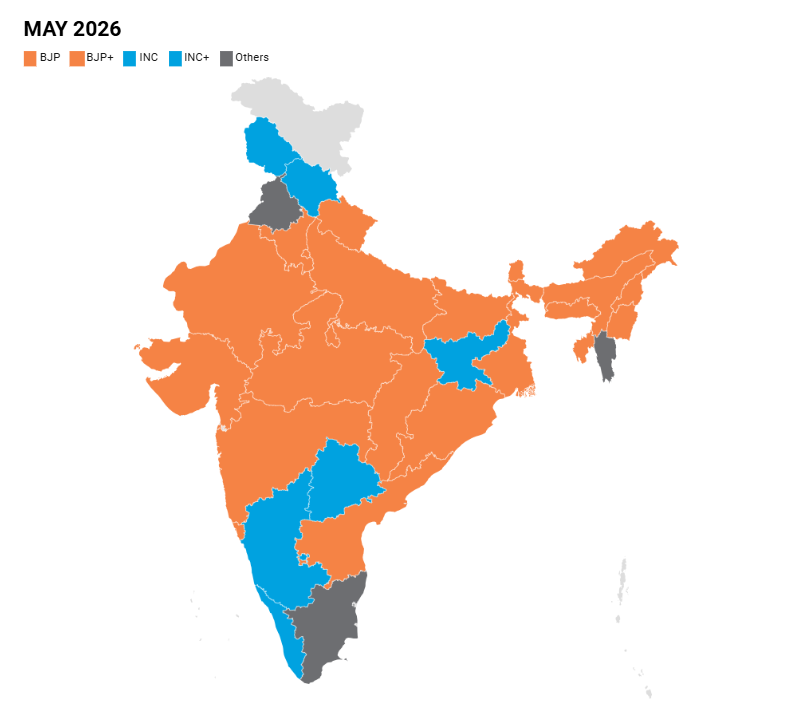
With its victory in West Bengal, BJP has now formed a government in another state long considered politically elusive for the party. BJP won 207 out of 294 assembly seats.The party’s rise across eastern and northeastern India has also reflected a larger political shift over the past decade. Once viewed largely as a Hindi-heartland force, BJP has steadily expanded into regions where it historically had little organisational presence, benefiting from a mix of organisational growth, welfare outreach, leadership projection and the decline or fragmentation of opposition parties.BJP national spokesperson Shehzad Poonawalla said the party’s expansion under Prime Minister Modi reflected its governance model and increasing public acceptance.“Under Prime Minister Modi’s leadership, the BJP and NDA have continuously expanded their political footprint across India on the basis of governance, performance and delivery. States that never had a BJP government or BJP chief minister earlier have elected BJP governments after Modi became prime minister,” he said.“Prime Minister Modi has now become synonymous with pro-incumbency. In recent elections, BJP-NDA governments in states like Assam and Puducherry have been voted back to power, while governments in several opposition-ruled states have faced anti-incumbency,” he added.With West Bengal now added to its tally, the BJP’s rise marks one of the most significant political expansions in post-Independence India — transforming the party from a largely Hindi-heartland force into a dominant pan-India political machine.