
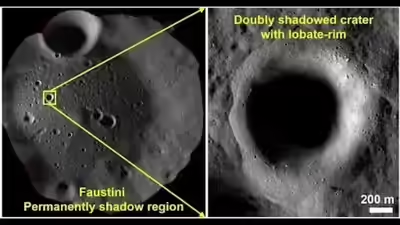
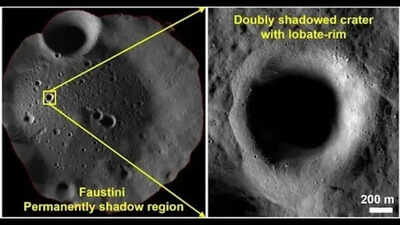
BENGALURU: Scientists working with India’s Chandrayaan-2 spacecraft have discovered strong evidence of ice buried beneath the floor of the Moon’s south pole region in “doubly-shadowed” craters, a finding that could prove critical for future human missions to the lunar surface.The discovery, published this week in the Nature portfolio journal “npj Space Exploration”, was made by researchers at the Physical Research Laboratory in Ahmedabad, who analysed radar data beamed back from the Chandrayaan-2 orbiter, which has been circling the Moon since 2019.The ice is not sitting on the surface where astronauts could simply scoop it up. It lies underground, hidden inside some of the most extreme environments in the entire solar system — craters so deep and so permanently in shadow that sunlight has never once touched their floors.Some of these craters sit inside other craters that are themselves permanently dark, creating what scientists call “doubly shadowed” regions. Temperatures there hover around minus 248 degrees Celsius, cold enough to keep ice frozen for billions of years.It is precisely because of that extraordinary cold that the ice has survived at all. And it is precisely because of that darkness that finding it has taken so long.The Chandrayaan-2 spacecraft carries a specialised radar instrument — the Dual Frequency Synthetic Aperture Radar, or DFSAR — described by Isro as ‘the first fully-polarimetric SAR to study the Moon”.Rather than taking photographs, it fires microwave signals at the lunar surface and reads how they bounce back. Ice scatters those signals in a distinctive way that rock and dust simply do not.Isro said scientists had “identified radar signatures consistent with the possible presence of subsurface ice beneath the floors of four doubly shadowed craters in the lunar South Polar Region”.Of the nine craters studied, one stands out. A small crater just 1.1km wide, nestled inside the larger Faustini crater, shows what the researchers describe as the strongest evidence of all.Its tell-tale radar readings are reinforced by something visible even in imagery: its rim has an unusual, flowing, lobed shape, the kind of outline you would expect if a meteorite had slammed into ground containing ice, causing it to slosh outward before freezing in place.Isro noted the crater is “characterised by lobate-rim morphology,” adding that “the impact may have penetrated subsurface ice, producing the observed lobate-rim crater.”Why does any of this matter to anyone beyond a handful of planetary scientists? Because water is heavy, expensive and extraordinarily difficult to launch from Earth.Any future crewed base on the Moon, whether Indian, American or otherwise, would need a local supply. Ice that can be mined, melted and purified could provide drinking water, and can also be split into hydrogen and oxygen to make rocket fuel.The Moon’s south pole, long suspected to harbour such reserves, has become the most contested real estate in the new space race. Nasa’s Artemis programme, China’s lunar ambitions and India’s own plans all converge on the same icy patch of darkness.Isro said the findings “have significant implications for future lunar exploration missions, including identification of potential ice-bearing regions for future landing and in-situ resource utilisation activities.”