
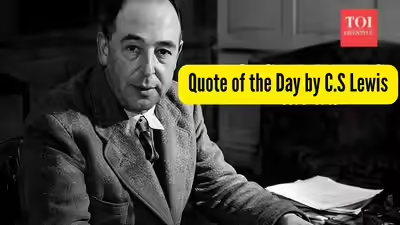
One of the most iconic writers and thinkers of the 20th century was Clive Staples Lewis, popularly known as C.S. Lewis. He was born in Belfast, Ireland in 1898. His family valued books, creativity, and a love of learning. Lewis liked stories and myths from a young age. He and his brother would often tell each other stories about made-up worlds. But his childhood was also sad. In 1908, his mother died of cancer, which had a big effect on him and made him lose faith in God at a young age.Lewis’s early education took place in England, where he attended several different schools. Later, he worked with a private tutor, William T. Kirkpatrick, who greatly affected his intellectual development. Kirkpatrick taught Lewis how to think clearly, use logic, and argue effectively, skills that would later be important in his writing and teaching. After that, Lewis studied at University College, Oxford, where he did very well academically.He was an officer in the British Army during World War I, which got in the way of his schooling. He got hurt in battle and was sent home, where he finished his studies at Oxford. The war changed him a lot; it made him see pain and loss, and it changed how he saw the world even more. After he graduated from school, Lewis began an academic career at Oxford University, where he became a well-known English literature scholar and teacher. He later became the Chair of Mediaeval and Renaissance Literature at Cambridge University. In school, he read mediaeval texts, Renaissance poetry, and literary criticism. People knew him for how clearly he thought and how well he could explain hard ideas to a lot of people.One of the biggest changes in Lewis’s life was when he became a Christian again. He was an atheist as a kid, but he slowly started to believe in God again when he was in his early 30s. He changed because he read philosophy and literature and talked to close friends like J.R.R. Tolkien. Lewis said that his conversion was a reluctant but unavoidable realisation of the truth of Christianity. A lot of his later writing would be very different because of this.A lot of people like Lewis’s writing style because it is clear, funny, and original. He was very good at making complicated philosophical and religious ideas fun and easy to understand. He often uses stories, metaphors, and comparisons to help people understand difficult ideas. His work was easy for both scholars and regular people to read because of this mix.He is probably best known for his Christian apologetics, which is when he defended and explained the Christian faith. “Mere Christianity,” “The Problem of Pain,” and “The Screwtape Letters” are all books that talk about faith, morality, suffering, and what it means to be human. In these books, Lewis doesn’t just make arguments; he also makes readers think deeply by honestly and humbly answering their questions and doubts.In addition to his religious books, Lewis was a very popular fiction writer. “The Chronicles of Narnia,” a series of seven fantasy books for kids, is his most famous work. These books have been loved by readers for generations because they mix imaginative stories with moral and spiritual themes to create a rich and symbolic world. Lewis uses characters like Aslan, Lucy, and Edmund to talk about sacrifice, redemption, courage, and faith.Another important part of Lewis’s life was that he was part of a group of writers called the Inklings, which included J.R.R. Tolkien. This group got together a lot to read each other’s work and give each other feedback. This made them feel better and gave them someone to talk to. These talks were very important in the making of some of the most famous modern books.Lewis did more than just write. During World War II, he gave a number of radio talks for the BBC. These talks later became the basis for the book “Mere Christianity.” During a time when things were tough and uncertain, these broadcasts made him a well-known public figure and spread his ideas to a lot of people. People liked how he could talk about faith and life in a clear and thoughtful way.People knew Lewis as a kind, humble, and very responsible person in his private life. He lived with his brother for a long time before marrying Joy Davidman, an American writer. He was very happy in their relationship, but he was also very sad when she died of cancer a few years after they got married. Lewis writes about love, loss, and faith in the face of pain in “A Grief Observed.” The book makes it very clear how sad he is.On November 22, 1963, just a week before his 65th birthday, C.S. Lewis died. His legacy has grown and lasted through the years. People remember him today as a writer who combined faith with reason, imagination, and logic.C.S. Lewis was an incredible person whose life and work still inspire millions of people. His ability to answer deep questions clearly and creatively has had a lasting effect on literature, theology, and popular culture. Lewis is still a wise and insightful voice, whether he is writing for school, telling stories, or writing about faith and life. He wants people to think deeply about the world and their role in it.Quote of the DayOne of the most iconic lines of C.S. Lewis is, “If we find ourselves with a desire that nothing in this world can satisfy, the most probable explanation is that we were made for another world.” These lines imply that human desire transcends material necessities, accomplishments, or temporal pleasures, indicating a deeper, potentially spiritual aspect of existence. The main idea behind the statement is that people’s wants and needs are not random, but have meaning. Most of the time, our wants are real things: hunger means food, thirst means water, and curiosity means knowledge. In most cases, these desires can be met in the real world. However, some longings seem impossible to fully satisfy with anything earthly, such as the desire for perfect happiness, unconditional love, lasting peace, or complete fulfillment. Despite achieving what they desire, people still feel unhappy. This lingering unhappiness makes us ask an important question: why do these desires exist if they can’t be met here? This “other world” need not be exclusively interpreted through a religious lens, despite its frequent association with concepts of heaven or a spiritual afterlife. More broadly, it can be conceived as a superior state of being, a realm of absolute truth, or a profound connection to meaning and purpose that remains elusive within the confines of daily life.Also, the quote can be seen as a reminder to think about what really matters. The quote sums up the conflict between what it means to be human and what people want to be. We live in a world that has limits, but we seem to want something that has no limits. This paradox might be what makes us human. The quote reminds us that our desires might be pointing us toward something greater than what we can see, a reality where our deepest longings finally come true, whether we think of the “other world” as a real place, a spiritual reality, or a metaphor for something deeper.