
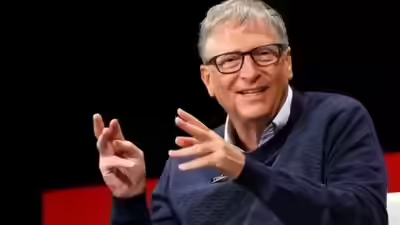

Bill Gates has flagged a quiet but pointed concern with the Trump administration’s growing habit of picking up equity stakes in private American companies, warning that the practice could end up rewarding ownership over engineering. Speaking to CNBC, the Microsoft co-founder said the trouble starts when the government begins favouring firms it part-owns over rivals with better technology. His larger worry is predictability: factory builds and chip fabs are 20-year bets, and policy that shifts on a weekly news cycle makes those bets harder to price.“Government operates best when it’s kind of predictable,” Gates told CNBC, adding that companies need to know what tariffs will look like for the next 20 years before they pour billions into a plant. The unease, he said, is about intent. Is Washington helping a nascent technology for the good of the country and treating all companies equally, or is it building a portfolio it then wants to protect? “The rules of the game we’re playing are pretty unclear right now,” he said.
From Intel to IBM, Washington’s shareholder list keeps growing
The list is long and getting longer. The federal government took a 9.9% stake in Intel last August, paying $20.47 a share for $8.9 billion worth of stock. That holding has since quadrupled in paper value to roughly $36 billion as Intel shares rallied past their dot-com peak. In May, the Commerce Department lined up $2 billion in equity across nine quantum computing firms, with $1 billion going into IBM’s new Albany-based quantum chip foundry, Anderon, and $375 million into GlobalFoundries for a 1% slice. D-Wave, Rigetti, Infleqtion, PsiQuantum, Atom Computing and Quantinuum each picked up around $100 million. Diraq took up to $38 million.The pattern repeats in critical minerals. The administration owns roughly 15% of MP Materials, 10% of USA Rare Earth through a $1.6 billion debt-and-equity package, 10% of Korea Zinc’s Tennessee smelter joint venture, 10% of Trilogy Metals with warrants for another 7.5%, and 5% of Lithium Americas. A stake in Greenland’s Tanbreez deposit, run by Critical Metals, is reportedly under discussion.
AI companies are next on US government’s runway
President Trump has now turned to AI. On Wednesday he said he plans to meet “12 or 15” top AI executives soon to discuss “giving back something to the public,” echoing remarks made days earlier on Air Force One. OpenAI‘s Sam Altman has been floating a “Public Wealth Fund” since 2021, where AI firms would donate equity to a government-run vehicle that pays dividends to citizens. Senator Bernie Sanders has gone further, suggesting a one-time 50% tax paid in stock. CNBC has confirmed Altman and the White House have been in talks about a possible OpenAI stake for over a year. Anthropic CEO Dario Amodei met senior White House officials a few weeks ago.
When the regulator owns the stock, who wins the contract?
Gates’ point lands at the seam between industrial policy and competition policy. Picking winners is one thing. Picking winners after buying shares in them is another. A government that holds Intel stock carries a different incentive when reviewing an antitrust case, awarding a defence contract, or shaping export controls. The Intel position alone has gained roughly $27 billion on paper since August. That’s good news for taxpayers, and a quiet complication for everyone else trying to out-engineer the chipmaker. Predictability, Gates said, is what builds factories. The current map of US government holdings is anything but.