


MUMBAI: Banks have made a host of suggestions on how govt could attract $30–$50bn foreign exchange, most of them involving the central bank subsidising the hedging cost of the foreign exchange.While the interest rate differential between India and the US is far less than the 4–5% in 2013, bankers say that the macroeconomic fundamentals are strong and will facilitate wholesale borrowing.

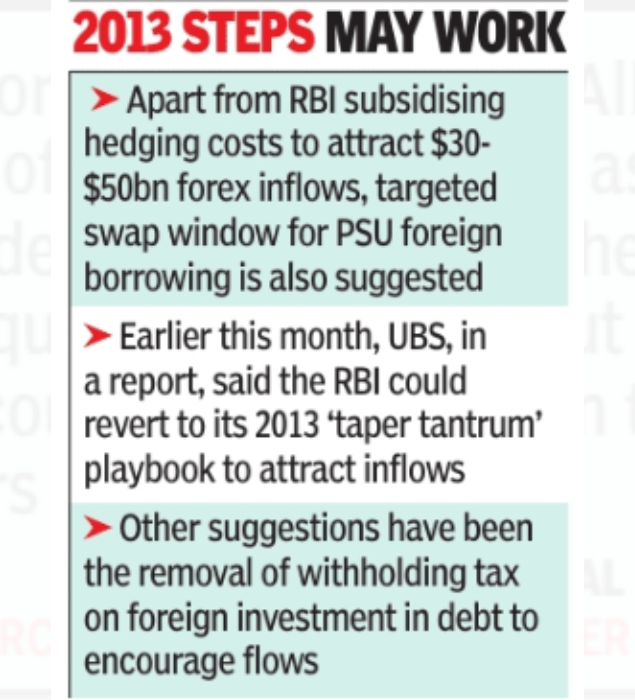
In 2013, RBI turned the tide through foreign currency non-resident (FCNR-B) deposits at a pre-determined rate, enabling banks to deploy the rupee proceeds. “Instead of a broad-based FCNR(B) scheme, the RBI could do the swap with the proceeds of foreign borrowing by public sector enterprises, particularly oil companies, through external commercial borrowings or foreign currency borrowings. The cheaper borrowings will offset their losses on product sales, the capital will be useful to increase domestic capacity and at the same time boost forex reserves by $30bn to $40bn,” said Ashishh Vaidya, head of treasury at DBS India.A scheme to raise funds in tens of billions is seen as crucial to change the sentiment.“Once the inflows come in, it will also release another $30–$40 billion locked overseas because of leads and lags by importers and exporters,” said Vaidya. Other suggestions have been the removal of withholding tax on foreign investment in debt to encourage flows.Earlier this month, UBS, in a report, said the RBI could revert to its 2013 playbook to attract inflows. During the 2013 taper tantrum, the RBI announced a slew of measures aimed at restoring external stability and arresting the sharp depreciation.Key steps included: (a) an increase in the Marginal Standing Facility (MSF) rate and bank rate by 200 bps to 10.25%; (b) issuance of fresh FCNR (B) deposits with a minimum tenure of three years and above, offered at a fixed rate of 3.5% per annum—this scheme garnered approximately $26bn, providing a significant buffer to FX reserves; (c) a special FX swap window was introduced for oil marketing companies (OMCs) to meet their daily dollar requirements, thereby reducing pressure on the spot FX market; (d) deregulation of interest rates on NRE/NRO deposits; (e) aggressively raising import duty (from 4% to 15% in phases) and restricting gold imports; and lastly (f) the RBI also resorted to subsequent policy rate hikes.