








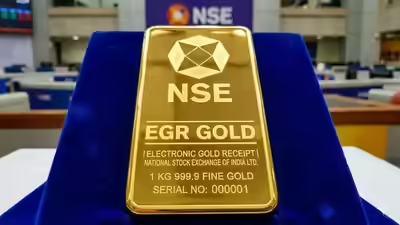
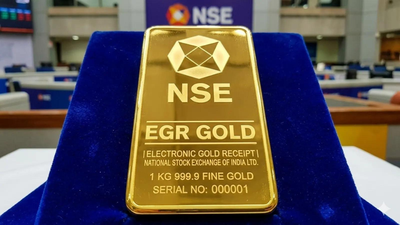
Trading in Electronic Gold Receipts (EGRs) on the National Stock Exchange (NSE) begins from May 18, marking a significant change in India’s organised gold market and offering investors a new way to buy and hold the precious metal in digital form, ET reported.The market will operate from Monday to Friday between 9 am and 11:30 pm, extending to 11:55 pm during the US daylight saving period, with settlements taking place under a T+1 cycle. Participants are expected to include retail investors, jewellers, bullion traders, refineries and other market stakeholders.The launch of EGRs represents one of the biggest structural shifts in gold investing in recent years, allowing investors to own gold electronically while being backed by actual physical gold stored in Securities and Exchange Board of India (SEBI)-regulated vaults.Like shares and other securities, ownership of the underlying gold will be reflected directly in investors’ demat accounts.
Why EGRs matter
For decades, gold has remained a preferred store of value in Indian households, often serving as a symbol of wealth, security and family inheritance. However, ownership of physical gold has traditionally involved concerns around purity, storage costs, theft risk and resale deductions.EGRs are designed to address some of these limitations while preserving exposure to gold prices.
What exactly is an Electronic Gold Receipt?
An Electronic Gold Receipt is essentially a digital representation of ownership of physical gold. Each receipt corresponds to a fixed quantity of gold stored in regulated vaults within a framework involving exchanges, clearing corporations, depositories and licensed vault managers.The receipts will be available in different denominations including 1 kilogram, 100 grams, 10 grams, 1 gram and 100 milligrams, potentially broadening participation across different investor categories, according to ET report.The product enters a market where investors already have multiple options to gain exposure to gold, including physical gold purchases, gold exchange traded funds (ETFs), gold mutual funds and sovereign gold bonds.Physical gold involves direct ownership through jewellery, coins or bars. Gold ETFs allow exposure to prices without physically holding the metal, while gold mutual funds invest in gold-linked instruments. Sovereign Gold Bonds provide gold-linked returns through government securities.
How are EGRs different from other gold investments?
EGRs still face several challenges. Liquidity remains a key concern, as stronger institutional participation and active market-making may be needed to create confidence among retail investors. Broker support also remains limited, with several trading platforms yet to fully enable EGR transactions.There is also a behavioural challenge as many Indian households continue to associate gold ownership with physical possession rather than digital holdings.Taxation could also affect adoption. While EGR trades on exchange platforms do not attract GST, conversion of receipts into physical gold carries a 3 per cent GST levy.The broader objective of the EGR framework is to build a more transparent and regulated gold ecosystem while strengthening India’s role in global bullion markets.
What NSE says
According to the exchange, the system could eventually bring investors, jewellers, traders and refiners onto a unified platform and reduce dependence on fragmented city-level pricing structures.NSE Chief Business Development Officer Sriram Krishnan said the launch marks an important evolution in India’s engagement with gold, ET quoted .According to the exchange, NSE’s technology and liquidity framework could make gold investing more transparent, secure and accessible while integrating gold more closely into India’s capital market ecosystem.