








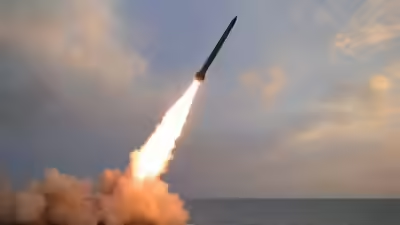
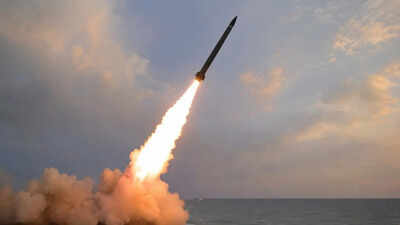
NEW DELHI: DRDO on Friday evening launched the maiden test of a nuclear-capable intercontinental ballistic missile (ICBM) off the Odisha coast.“Though the test-launch doesn’t look like that of an Agni-6 missile, the missile tested today is of ICBM category,” a defence source confirmed to TOI. However, DRDO has yet to officially announce the missile test.Days ago, TOI had reported that DRDO was going to launch a missile test of ICBM category.Only four countries — US, Russia, China and North Korea — possess ICBM technology and have deployed ICBMs with over 12,000-km range. France and Britain possess operational nuclear-armed submarine-launched ballistic missile (SLBM) technology. If India perfects ICBM capability, any country in the world, including the US, will come into its missile strike range.The launch came days after DRDO chairman Samir V Kamath, during a defence summit, had said about Agni-6 that “the moment govt gives permission, we are ready to move forward. All technical preparations are complete”.The possession of nuclear-capable ICBM technology means the ability to respond to a nuclear attack, thus preventing any country from attacking first. It also demonstrates mastery in complex rocket propulsion, guidance systems and re-entry technology.Last Wednesday, BJP also dropped a big hint on the Agni-6 launch when it posted on X, “Agni-6: India marching towards becoming a superpower! With a strike range of 10,000+ km and MIRV technology, Agni-6 is ready to make history. This missile will make India’s security impregnable and place us in the league of the world’s most powerful nations. Powerful India, Secure India!” BJP had also uploaded a video in which it explained that till now, only “five countries have the power of intercontinental ballistic missiles: America, Russia, China, France and Britain. Now, India is going to strengthen its position in the same league. With the strike power of long distance, India’s reach is not only going to be regional but also going to be more global”.The possession of the nuclear-capable ICBM technology means the ability to respond to a nuclear attack, thus preventing any country in the world from attacking first. It also demonstrates mastery in complex rocket propulsion, guidance systems and re-entry technology.While Russia operates the longest-range missiles, including the RS-28 Sarmat and R-29RMU2.1 Layner, both capable of exceeding 12,000 km, China has fielded DF-41 (Dongfeng-41), which is considered a top-tier ICBM with a confirmed range of 12,000–15,000 km. The US possesses the LGM-30G Minuteman III and the upcoming LGM-35 Sentinel, which meet or exceed intercontinental distance requirements. North Korea had in the past tested missiles with ranges nearing 10,000 km–15,000 km
India gets tech to turn ‘dumb’ warhead into ‘smart’ weapon
India has developed a glide weapon system technology that can convert an unguided (“dumb”) warhead into a guided (“smart”) weapon, marking its entry into an elite group of countries that possess advanced stand-off weapons capabilities, reports Surendra Singh. On Thursday, DRDO and IAF jointly conducted the first flight-trial of Tactical Advanced Range Augmentationweapon off Odisha’s coast, the defence ministry said Friday. The modular range extension kit is India’s first indigenous glide weapon system to convert unguided warheads into precision-guided weapons.