








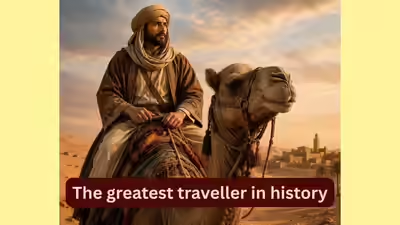
Ibn Battuta is a name that needs no introduction. Known as the greatest traveller in history, Battuta was born in 1304 in Tangier, Morocco. During his lifetime, Battuta travelled nearly 75,000 miles (nearly 1,20,700 km) across Africa, Asia, the Middle East and parts of Europe. Among the many reflections linked with his journeys, his one quote continues to remain relevant with travellers even today: “Traveling gives you home in a thousand strange places, then leaves you a stranger in your own land.”The quote might sound poetic but is as practical as it gets. But if you read again, you’ll find it contradictory too. Like how can travel make strange places feel like home while disconnecting someone from their actual homeland? But meet any avid traveller, speak with them and you’ll actually understand the raw emotions behind the famous quote. Traveling gives you home at strange placesThe first part of the quote, “Traveling gives you home in a thousand strange places,” shows the journey and extraordinary ability of travel to melt boundaries. When you start to travel, suddenly the world stops feeling strange. A tea seller in India remembers your regular order, a mountain Sherpa in Nepal shares stories over Maggie. A local family in Bhutan invites you to join for dinner. And gradually these strange places and these strangers become your home!Beyond continentsThese are the moments which create emotional ties across continents. Home is no longer limited to one address. Home then becomes more of a feeling. It’s all about finding comfort and human connection. Relevance in modern travel The idea is more relatable in modern travel with the concept of digital nomads. People are travelling without compromising on travel. The concept allows travellers to work from Bali cafés, Indian homestays and European beaches. The more people travel, the more they realise that kindness, curiosity and shared experiences is a universal concept. A crowded street market in Singapore may suddenly remind someone of Janpath market in Delhi. The rhythm of coastal life in Greece might feel familiar to a traveller from Goa. AdaptabilityTravel also teaches people to adapt to different situations and conditions. The unfamiliar gradually becomes ordinary. Navigating foreign train systems, talking to locals and relishing regional food in no time becomes second nature. In that sense, travellers end up making “homes” everywhere and no, we are not talking in literal sense, but emotional spaces. Space where one feels welcomed without being judged.The second half of the quote, “leaves you a stranger in your own land.” The second part is a little complex. The next and last part of the quote reveals the truth: “then leaves you a stranger in your own land.” It means travel changes people not from outside but from inside. It is not something that you’ll notice immediately but only after experiencing different cultures and lifestyles. Cultural shockSeveral travellers describe it as “reverse culture shock.” When you come back after visiting a bigger city, suddenly streets where once you grew up and knew so well start feeling smaller or more predictable. Conversations revolve around routines and you feel disconnected because of what you experienced outside. Comparison strikes in A person who has watched sunrise over the Thar Desert, trekked through the Himalayas or lived with tribals returns home carrying a different understanding of the world, the concept of time and belonging. Home remains important, but it no longer feels like the only centre of the world. That emotional shift is what Battuta captured centuries ago with remarkable precision.This is not necessarily a negative feeling. Travel also encourages empathy by forcing travellers to step outside their assumptions. Someone who has shared meals with strangers in rural villages abroad often returns home more aware of both privilege and inequality. Spiritual transformation For some, this transformation starts with a single journey. Like a pilgrimage in the mountains may reshape spiritual understanding or sometimes a short trip to a wildlife sanctuary can change your concept. Ibn Battuta’s journeys Ibn Battuta travelled the world for over 30 years and met some great people enroute. He met kings, queens, scholars, traders and ordinary people from completely different cultures. By the time he returned to Morocco, he was no longer the same young man. Some of Ibn Battuta’s remarkable travel achievement’s include:Hajj Pilgrimages (1326)Exploration of East Africa (1328–1330)Service as Qadi in Delhi and the Maldives (1334-1346)Ambassador to China (1345-1346)Documenting the Muslim World (The Rihla) (1325-1354)He recorded his journeys in A Gift to Those Who Contemplate the Wonders of Cities and the Marvels of Travelling which also known as The Rihla. Battuta came back as an evolved person and a changed man. And that’s the everlasting beauty of his quote which reminds us that travel is not simply between destinations, it is transformation.