







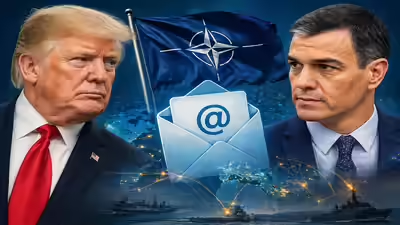
NEW DELHI: Fresh reports citing internal Pentagon discussions have reignited one of the biggest geopolitical questions of the decade: what happens if the United States breaks away from Nato, weakens its role inside the alliance, or begins punishing members it believes failed to support Washington during the Iran conflict?According to reports, internal US policy discussions explored options ranging from suspending Spain from Nato positions to reassessing support for Britain’s claim over the Falkland Islands, while President Donald Trump has again raised the possibility of US withdrawing from the alliance. These developments have exposed widening cracks inside the 76-year-old security bloc that has underpinned Western defence strategy since the aftermath of World War II.
The reports also suggest that Trump is deeply dissatisfied with several European allies, especially Spain, which reportedly refused to allow its bases or airspace to be used for operations against Iran. At the same time, Washington’s broader frustration appears tied to a long-running complaint that Europe depends on US military power while contributing too little in return.That raises two central questions. Can a Nato member be expelled against its will? Can the United States itself leave the alliance if it chooses to? And if America steps back, what would happen to European security, Russia deterrence, Middle East military logistics and the wider post-war global order?
Why the latest Pentagon leak matters
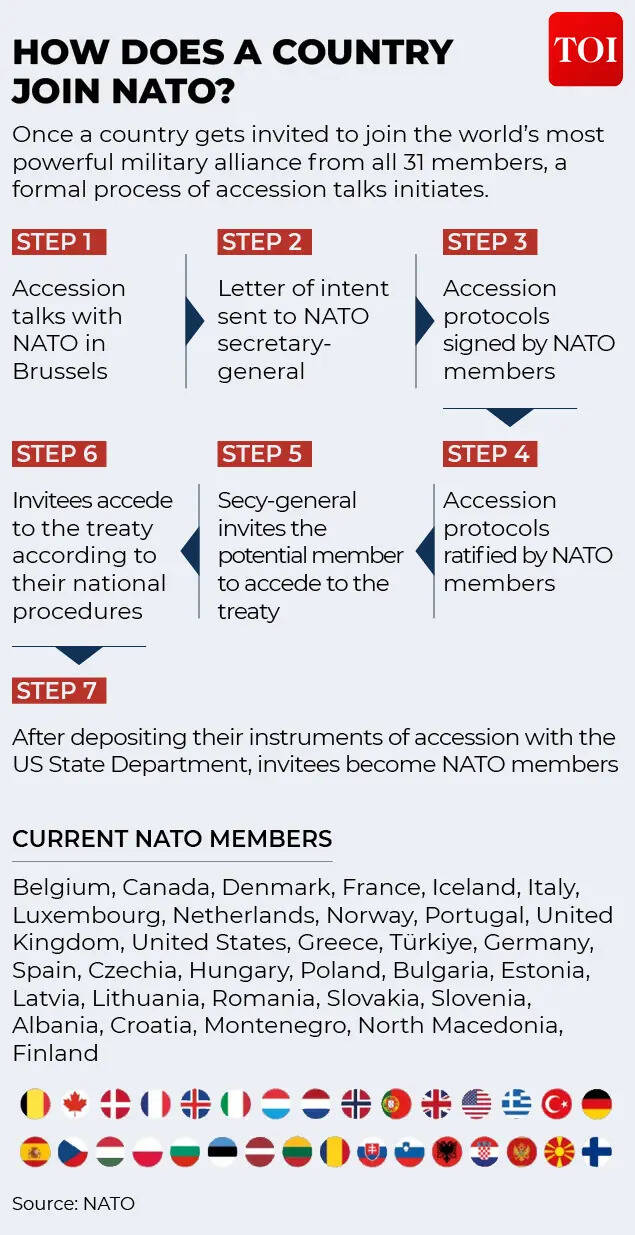
The reported Pentagon email is significant not because it signals an immediate US policy shift, but because it reveals serious thinking inside Washington about using Nato leverage to discipline allies. Reportedly discussed options included sidelining “difficult” countries from prestigious Nato roles, reconsidering US support for certain European territorial claims, and punishing allies seen as unhelpful during the Iran conflict.One reported line described access, basing and overflight rights as “just the absolute baseline for Nato.” That wording is telling. It suggests some in Washington believe alliance membership should automatically guarantee military cooperation when US requests it. Several European governments reject that interpretation, arguing Nato is a collective defence pact, not a blanket approval mechanism for every US military operation outside Nato territory. That disagreement lies at the heart of the current tensions.The North Atlantic Treaty Organization, or Nato, was created in 1949 after World War II to prevent another major conflict and contain Soviet expansion in Europe. Founded by the United States, Canada and Western European nations, it became the central pillar of transatlantic security during the Cold War. Today, Nato has 32 members, including US, UK, Germany, France, Italy, Spain, Poland, Finland and Sweden.
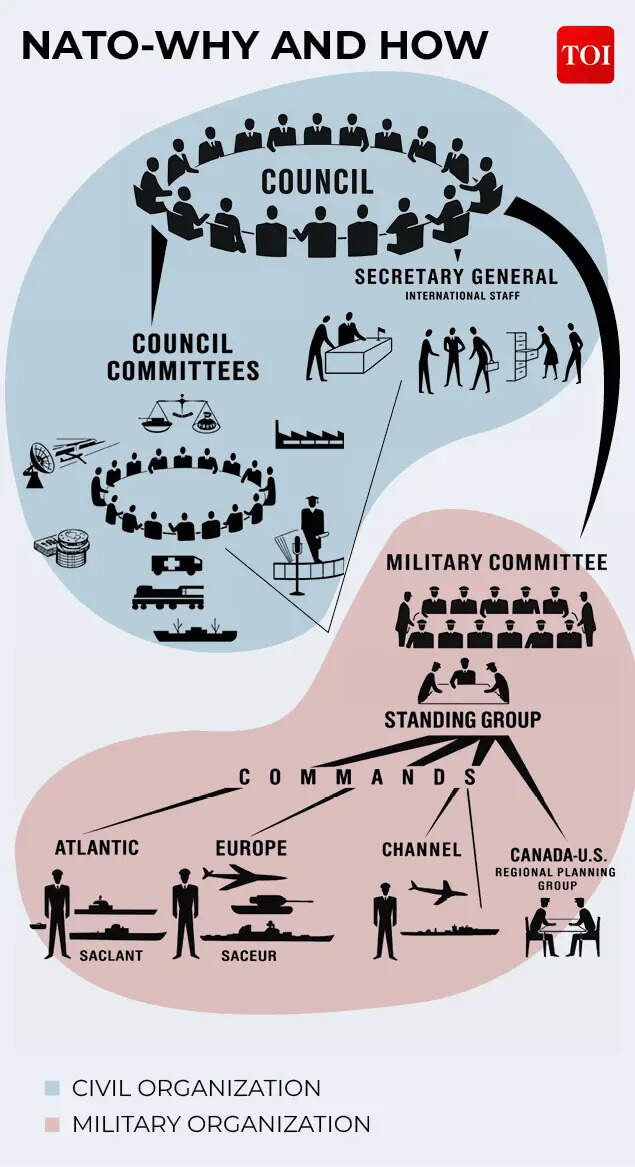
Its most important principle is Article 5, which states that an attack on one member is considered an attack on all. This collective defence guarantee has been formally invoked only once — after the September 11, 2001 attacks on the United States. Following that, European allies joined US-led military operations in Afghanistan, with many deploying troops and suffering casualties alongside American forces.That history matters today. Many European leaders argue they stood with Washington during America’s time of crisis, making current accusations of abandonment unfair. Donald Trump and his allies, however, say the recent Iran conflict exposed an alliance where many members were unwilling to provide support when US expected solidarity.Beyond political disputes, Nato has shaped the modern security order for more than seven decades — deterring the Soviet Union, intervening in the Balkans, operating in Afghanistan and strengthening Europe’s eastern flank against Russia.Yet Nato still depends heavily on the United States, which remains its largest military spender, key nuclear power, and main provider of intelligence, logistics and troop deployments. That is why every debate over America’s future role creates anxiety across the alliance.
Article 13 of Nato: Can a country be expelled?
Legally, this is where matters become complicated. Nato officials have publicly stated that the founding treaty contains no provision for suspending or expelling a member state. In practical terms, that means there is no straightforward mechanism to throw Spain or any other country out of the alliance against its will.This is why reports of “suspending Spain from Nato” are widely seen as referring less to formal membership removal and more to political or operational punishment. That could include blocking access to senior Nato roles, reducing influence in internal committees, or limiting participation in certain alliance functions. Any major internal decision in Nato generally requires consensus, meaning multiple members would need to agree, making unilateral action by Washington difficult.
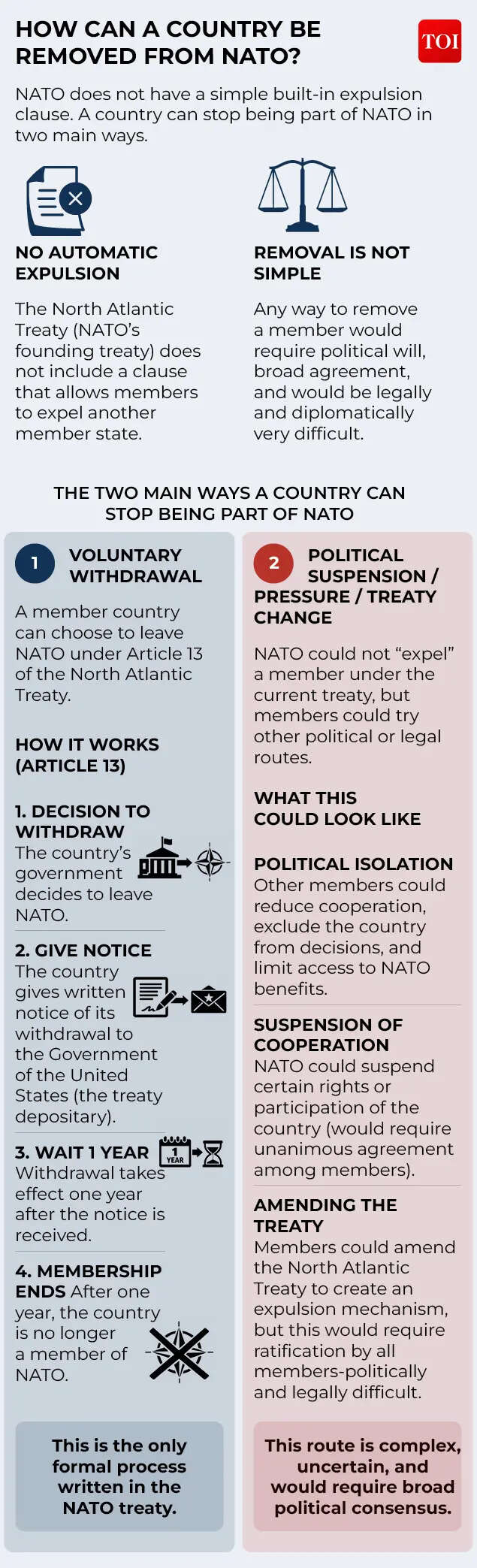
The key treaty provision often discussed in such moments is Article 13 of the North Atlantic Treaty. However, Article 13 does not deal with expulsion. Instead, it explains how a member country can voluntarily leave the alliance. Under the clause, any member may withdraw from Nato one year after formally notifying the Government of the United States, which acts as the treaty’s official depositary.In simple terms, Article 13 creates a legal exit route for countries that choose to leave, but it does not create any legal pathway for removing a country that wants to stay. That distinction is crucial in the current debate. Nato members can walk out, but forcing one out is far more complicated because the treaty does not clearly provide for it.Article 13 has also drawn renewed attention because President Donald Trump has repeatedly raised the possibility of the United States leaving the alliance. While the treaty technically permits withdrawal through the one-year notice process, domestic US law passed in 2023 adds further hurdles. Under that law, a president cannot unilaterally withdraw America from Nato without either a two-thirds vote in the Senate or an act of Congress.So while a member state can face diplomatic pressure, political isolation or reduced influence inside the alliance, formal expulsion is not currently built into Nato’s legal framework.
Can United States leave Nato?
This question is more serious because America is Nato’s central military power.Trump has repeatedly floated the idea of withdrawal, calling Nato a “one-way street” and arguing that US protects allies who do little in return.However, a US law passed in 2023 limits unilateral presidential withdrawal. Under that framework, a president cannot simply exit Nato alone. Withdrawal would require either a two-thirds Senate vote or an act of Congress.
That means a president can threaten withdrawal, weaken commitments, reduce troop presence, delay funding, or politically undermine the alliance. But a clean legal exit would face institutional barriers.Even so, many analysts warn that formal withdrawal is not the only danger. If Washington remains inside Nato but behaves unpredictably, doubts about US reliability could weaken deterrence almost as much as an actual exit.
Why Spain became a flashpoint
Spain has emerged as one of the most visible fault lines in the latest Nato tensions because it sits at the intersection of two issues that have deeply frustrated President Donald Trump’s administration: military cooperation during the Iran conflict and defence burden-sharing inside the alliance.The immediate trigger was Spain’s reported refusal to allow its territory, airspace or military facilities to be used for offensive operations against Iran. This was especially significant because Spain hosts two strategically important American military installations — Naval Station Rota and Morón Air Base. These bases are critical for US naval deployments, troop movement, refuelling operations and logistics between the Atlantic, Europe, Africa and the Middle East. For Washington, any restrictions from a host country during an active conflict are seen as a serious obstacle.From Madrid’s perspective, however, the issue was about sovereignty and legality. Prime Minister Pedro Sánchez’s government has maintained that Spain supports cooperation with allies, but within the framework of international law and Spain’s own national interests. In practical terms, that means Nato membership does not automatically translate into support for every US-led military campaign, especially one not formally authorised by the alliance.The second reason Spain became a flashpoint is defence spending. Trump has repeatedly singled out European allies that, in his view, rely too heavily on American military power while failing to contribute enough themselves. Spain has long been among the countries criticised by Washington for spending less on defence as a share of GDP compared with Nato’s evolving targets. Although Spain has increased spending commitments in recent years, it has often resisted pressure for dramatic hikes.That combination made Spain a politically convenient symbol for Washington. It represented both a country unwilling to support US operations in Iran and a government seen as reluctant on military expenditure. Reports that Pentagon officials discussed punitive measures against Madrid therefore carried symbolic weight beyond Spain itself. They were also meant as a warning to other allies that Washington expects more tangible support, both financially and strategically, from Nato members in the future.
The defence spending dispute behind everything
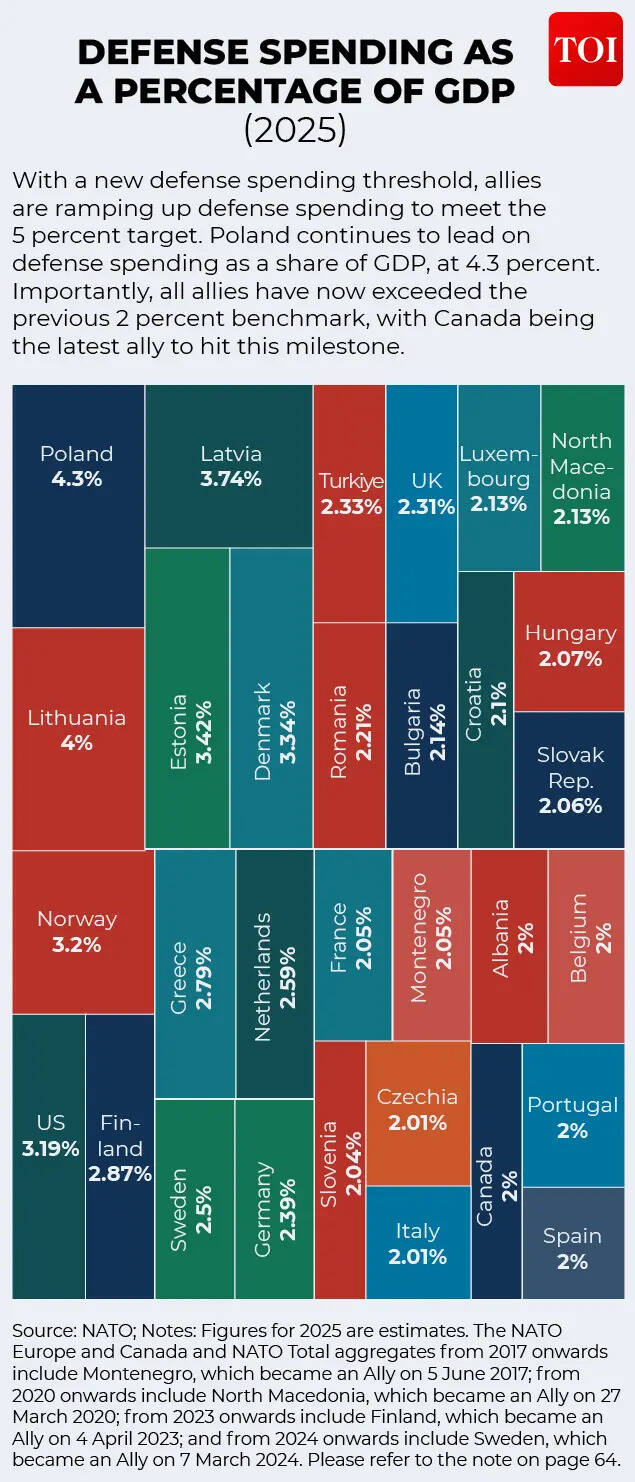
For years, Trump’s biggest complaint about Nato has been money.He argues US shoulders disproportionate defence costs while wealthy European states underinvest. That criticism has had political impact. Nato members have significantly increased defence spending since Russia’s invasion of Ukraine.By 2025, all members reportedly reached at least 2% of GDP spending targets. A newer benchmark aims for 3.5% on core defence plus another 1.5% on resilience and infrastructure by 2035.
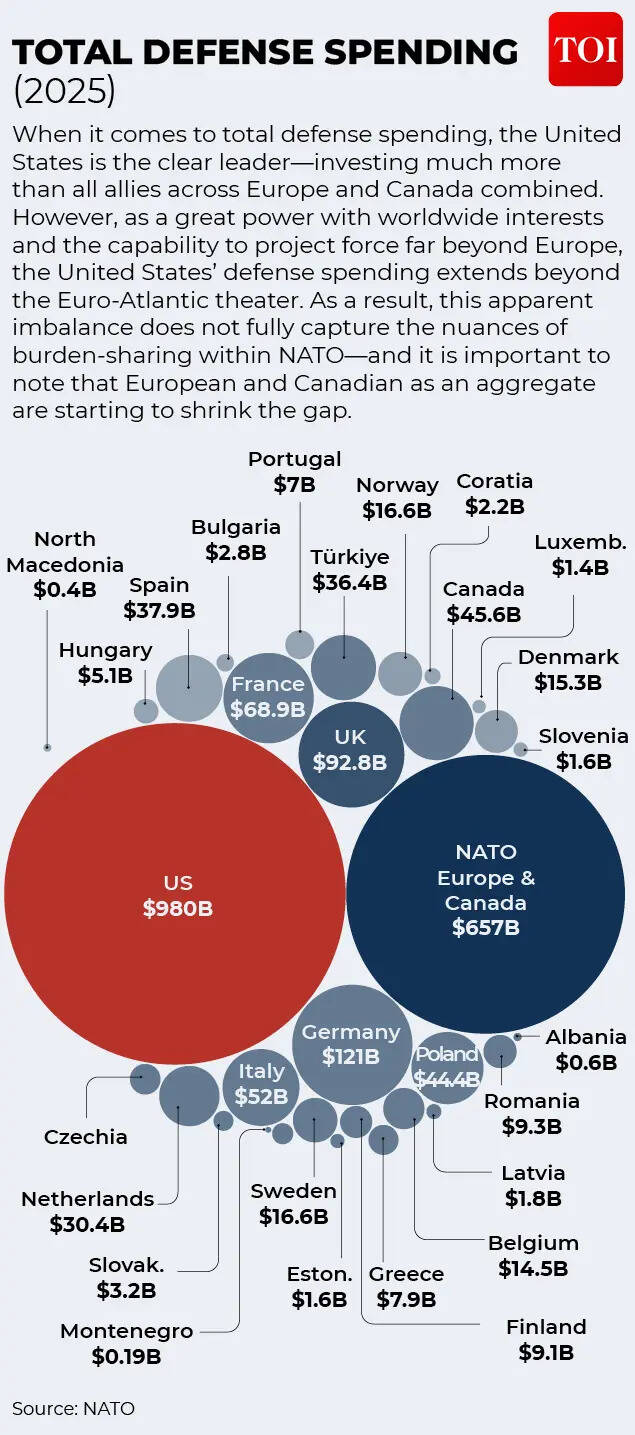
Yet in absolute cash terms, US still dominates alliance military expenditure, contributing hundreds of billions more than any other member.Washington sees this as a burden-sharing failure. Europeans counter that US military spending also supports America’s global ambitions beyond Nato, including Asia and the Middle East.Both arguments contain truth, which is why the dispute remains unresolved.
Why US still needs Nato
Despite repeated political criticism of the alliance, the United States still derives enormous strategic, military and economic value from Nato. While President Donald Trump and some voices in Washington have argued that the alliance is costly or unfair, the reality is that Nato remains one of America’s most effective force multipliers and a central pillar of US global power.The most immediate reason US still needs Nato is military reach. America’s vast network of bases, ports, airfields and logistics hubs across Europe gives Washington the ability to move troops, aircraft, ships and supplies quickly across multiple regions. US operations in the Middle East, North Africa and even parts of Asia often depend on infrastructure located in Nato countries. Bases in Germany, Italy, Spain, the United Kingdom and elsewhere have long served as launch points for missions, intelligence gathering, refuelling and emergency deployments. Without these facilities, US military would face higher costs, longer response times and more operational limitations.Nato also gives the United States unmatched political legitimacy. When Washington acts alongside allies rather than alone, its military actions carry greater diplomatic weight. Joint missions signal unity, distribute responsibility and reduce the perception of unilateral American intervention. Whether in Afghanistan after the September 11 attacks, anti-piracy patrols, or deterrence missions in Eastern Europe, Nato has provided US with a coalition structure no rival power can easily match.Another critical factor is deterrence against adversaries. Nato helps contain threats from Russia by ensuring that any attack on one member risks confrontation with the world’s most powerful military coalition. This reduces the likelihood of conflict and lowers the burden on US to defend Europe country by country. It is cheaper and safer for Washington to deter war collectively than to fight one later alone.
The alliance also strengthens America’s defence-industrial and intelligence advantages. Nato members buy US weapons systems, share surveillance data, cooperate on cyber threats and coordinate sanctions or diplomatic pressure during crises. These relationships expand American influence far beyond Europe.Most importantly, Nato is not simply about defending allies; it is about preserving a world order shaped by US leadership since World War II. If the United States walks away or weakens the alliance significantly, rivals such as Russia and China would gain space to challenge American influence. For that reason, even critics of Nato often recognise that abandoning it would cost US far more strategically than maintaining it.
What happens if US weakens commitment instead of leaving
This may be the most realistic scenario.Rather than formally quitting Nato, Washington could reduce troop deployments, shift forces only to favoured countries, cut diplomatic backing, or cast doubt on whether it would honour Article 5 automatically.That would create a two-speed alliance: countries seen as close to Trump might gain troops and favour, while others face pressure.Reports suggested supportive states could include Poland, Romania, Lithuania and Greece. These countries have boosted defence budgets and often take harder lines on Russia.Such selective treatment would transform Nato from a rules-based alliance into a politically tiered system.
Why Russia would watch closely
Nothing would please Moscow more than visible Nato division.Russia has long sought to test Western unity, exploit political fractures and weaken deterrence. If Europe doubts America and America doubts Europe, Russia gains room to pressure eastern flank states through hybrid warfare, cyberattacks, border provocations or coercive diplomacy.Many defence planners believe Nato’s greatest strength is not just weapons, but belief. If adversaries think the alliance will respond together, deterrence works.
What it means for Britain and Falklands
The Pentagon leak also reportedly mentioned reconsidering US diplomatic support for Britain’s Falklands claim.Even if symbolic, this matters politically. The UK has long seen itself as Washington’s closest ally. Any use of sovereignty disputes as leverage would signal a much more transactional US foreign policy.It would also warn allies that no historical relationship guarantees protection if current policy differences emerge.
Could Nato survive without US?
Technically yes, strategically with difficulty.European Nato members together possess large economies, advanced militaries and industrial capacity. But they still depend heavily on US for intelligence, nuclear deterrence, airlift, missile defence, command systems and rapid reinforcement.Without America, Europe could eventually build a credible autonomous defence structure, but not overnight.The transition period would be dangerous because adversaries may test weakness during adjustment.The immediate likelihood of US formally leaving Nato remains uncertain and legally difficult. There is no clear treaty route to expel Spain or other members either. But the larger danger is not paperwork. It is political erosion.If Washington increasingly treats Nato as conditional, and Europe increasingly plans around US unreliability, the alliance could weaken from within even while all members remain formally inside it.That would mark a historic shift in the post-World War II order. Nato has endured the Cold War, Balkan wars, Afghanistan and Russia’s aggression in Ukraine. Its next challenge may come not from an external enemy, but from disagreement over what the alliance is supposed to be.If the United States truly splits from Nato — legally, politically or psychologically — the consequences would reach far beyond Europe. It would reshape deterrence against Russia, military operations in the Middle East, transatlantic trade politics and the global balance of power.The question is no longer whether Nato faces pressure. It is whether the alliance can adapt before internal mistrust becomes permanent.