






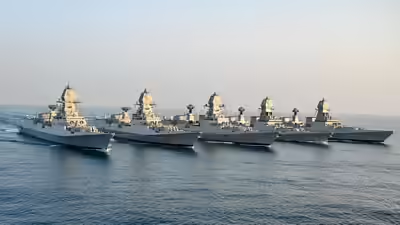
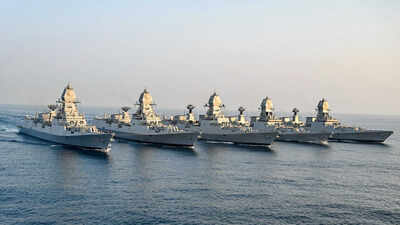
The closure of the Strait of Hormuz has once again put the spotlight on the global dependence on maritime trade. The closure of the critical waterway has restricted access to 20% of the global hydrocarbon trade, causing turmoil in the global energy market.The closure of the strait has now become a key point of contention between the two warring sides. This issue has led to the Americans blockading Iranian ports, effectively isolating Iran from global trade.In recent times, the threat to shipping in an increasingly interconnected world has drawn sharp responses from the global community. Many nations, including India, have deployed ships to protect maritime traffic traversing through the Bab el-Mandeb during the threat of Houthi rocket attacks, as well as during the height of Somali pirate activity.
The dangers of maritime chokepoints
For centuries, access to the sea has been thought of as a blessing for any nation. After all, one can be connected to the wider world via the oceans. Even today, with impressive rail and road linkages as well as an expanding commercial air sector, being landlocked is still thought of as a disadvantage. On land, geography is king; it often dictates the growth trajectory a country would take. Seas, on the other hand, are usually thought of as open highways, but the intersection of the open sea and geography can create chokepoints or bottlenecks that can restrict the movement of ships, as is currently being demonstrated by the bottling up of the Persian Gulf due to Iranian actions at the Strait of Hormuz.
China’s big Malacca worry
The Malacca Strait is the shortest route between the Indian and the Pacific oceans. This maritime trade route is used extensively as a conduit for manufactured goods produced in East and South East Asia, predominantly from China, heading to Europe and West Asia. Meanwhile, crude oil and gas flow the other way from West Asia towards China through this strait. Nearly 75–80% of China’s energy requirements now pass through this waterbody.China has long considered the Malacca Strait a major worry for its energy security. China has tried to use the more southern Lombok and Sunda straits to bypass the Malacca Strait, but these deviations add 1,800 km and 3,000 km respectively to the journey. This adds to both the cost and time of crude imports into China.
India a growing maritime power
As India grows, it is investing in its port infrastructure. The aim of the exercise is to exert India’s influence both economically and militarily. The government of India is investing Rs 6.06 lakh crore in 845 maritime projects under the Sagarmala initiative. Projects worth Rs 1.57 lakh crore have already been completed.One of the most important projects for India is the Great Nicobar Island Project. This initiative, as per a publication by the Andaman & Nicobar Union Territory administration, will cost Rs 1 lakh crore.
Great Nicobar Island Project
The Great Nicobar Island Project is a strategically important initiative for New Delhi, both economically and militarily. The island is being developed as a major port and trans-shipment hub. The programme will improve infrastructure in India’s southernmost landmass, Great Nicobar Island, where Indira Point is located.The island lies about 40 nautical miles (74 km) from international shipping lanes passing through the Strait of Malacca, the busiest waterway in the world. Two key international waterways straddle the Nicobar archipelago: the 10-degree channel separates this island group from the Andamans to the north, and the 80-km-wide Six Degree Channel separates it from Sumatra in Indonesia to the south.The government is planning to construct an International Container Transhipment Terminal (ICTT), an international airport, and a township on the island. A transhipment terminal handles containers from bulk carrier ships, stores them, and transfers them to other vessels for onward transport. This will reduce dependency on foreign ICTTs such as Colombo, Dubai, and Singapore, and is expected to save the country millions of dollars annually in foreign exchange.India currently has two operational transhipment terminals located at Kochi and Vizhinjam, with the latter being India’s only deep-water hub. The upcoming hubs at Vadhavan port and Great Nicobar Island are both deep-water ports capable of handling some of the largest container ships in the world.The ICTT is being built at Galathea Bay under the Maritime India Vision 2030, with the aim of integrating the project into the global maritime economy. There are also plans to establish a 450 MW gas and solar power plant on the island to support these developments.
India’s unsinkable aircraft carrier
India, through the Andaman & Nicobar Archipelago, is strategically positioned to monitor and potentially influence traffic flowing through the Strait of Malacca. About 82,000 ships carrying nearly 40% of global trade pass through this waterway annually.Great Nicobar Island lies roughly 150 km from the western entrance to the Malacca Strait and nearly 1,250 km from Singapore. The island group can also deploy aircraft to monitor the Sunda and Lombok straits, located roughly 2,000 km and 3,000 km away, respectively.The Andaman and Nicobar Islands are also India’s gateway not only to South East and East Asia but also to the west coast of the United States.The armed forces currently maintain a continuous presence through four airbases, monitoring China’s primary sea access routes to the Indian Ocean. The new greenfield international airport will include a naval enclave, with 100 acres allocated for defence use, according to local authorities.“The infrastructure coming up in the area will reduce the reaction time in case of any contingency in the region. Good civilian infrastructure will help build naval infrastructure as well,” said a source in the Navy. “Once the infrastructure is in place, scaling up operations will be easier as logistics and communications improve. This will enhance the armed forces’ ability to operate across the wider region.”The Tri-services commandThe island group hosts India’s only tri-services command called the Andaman & Nicobar Command (ANC). This command has elements of the army, navy and the air force. It was formed to protect India’s interests in the area.The Coast Guard too maintains a strong presence in the area. The force has been fighting drug smuggling, human trafficking and illegal fishing in the area.
Concerns over the project
Environmentalists have raised concerns over the impact of these projects on the local flora and fauna, with many of these endemic to the archipelago. The National Green Tribunal (NGT) dismissed a series of pleas linked to the project earlier this year. The NGT stated that the environment clearance given previously to the project was backed by sufficient safeguards and that there was no good ground to interfere.Environment Minister Bhupender Yadav, had stated last year that the local Shompen and Nicobarese tribals are only being replaced from the New Chingen area and that no other tribal area has been disturbed.The minister had also stated that the total tribal area on the island stands at 751 square km, while the area earmarked for the new developments from the tribal fold is 84 square km. The government is re-notifying 76 square kilometers as compensation. The island has a total land mass of 921 sq km as per the UT government.